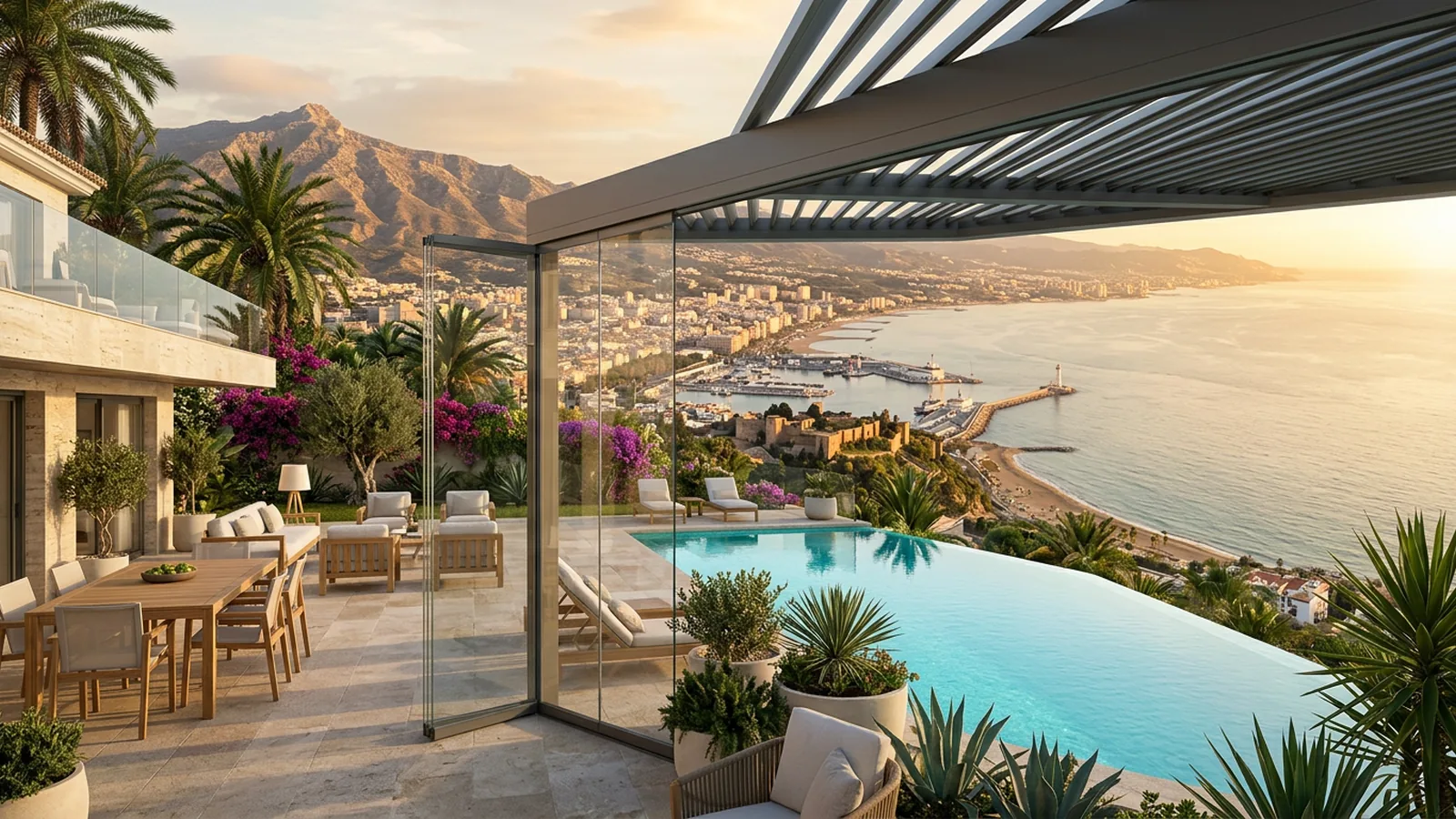
Parasols & Shade Sails in Málaga
Premium parasols & shade sails for your Málaga home — designed and installed by trusted local pros. Free, no-obligation quotes.
Get Your Free QuotePremium Parasoles y Sombrillas Grandes in Málaga: The Ultimate Guide to Wind-Resistant, Marine-Grade Shade
Málaga capital is undergoing an unprecedented golden age. As the vibrant heart of the Comarca Málaga - Costa del Sol, the city’s population has climbed from 593,333 inhabitants (as of January 1, 2024) to 597,173 inhabitants (as of January 1, 2025), according to the municipal register (padrón). This growth is accompanied by an incredibly diverse, cosmopolitan demographic. Unlike traditional expat enclaves on the coast like Marbella or Mijas, which are heavily British-dominated, Málaga capital is a global hub home to 162 nationalities. Around 12 percent of the population (71,177 registered foreign residents as of January 1, 2025) is international, comprising 57,917 non-EU citizens and 13,260 EU citizens.
The demographic landscape is led by Moroccan nationals (10,568), followed by Ukrainians (6,471), Colombians (5,580), Paraguayans (5,489), Italians (5,022), Venezuelans (3,889), Argentinians (3,696), Chinese (3,541), Romanians (1,789), and Russians (1,780). This unique mix creates two distinct property profiles. While many Eastern European and Latin American residents occupy the high-volume rental market, a highly affluent segment of digital nomads, Italian executives, Northern Europeans, and premium buyers are investing heavily in Málaga’s most exclusive residential zones.
From the hillside villas of El Limonar, Cerrado de Calderón, El Morlaco, and Cerro del Toril (Málaga Este) to the traditional beachfront properties of Pedregalejo and El Palo, and the modern, upscale penthouses of Teatinos-Universidad, outdoor living is the ultimate luxury. However, creating a comfortable outdoor space in Málaga requires specialized, high-performance shade solutions. With intense UV radiation, high salt-air corrosion, and violent local wind patterns, standard domestic umbrellas simply will not survive.
The Málaga Climate: Why Cheap Parasols Fail
Designing outdoor spaces in Málaga requires a deep understanding of the local geography. Nestled on the Bay of Málaga, bordered by the steep Montes de Málaga mountain range to the north and the Guadalhorce River delta to the west, the city experiences microclimates that demand heavy-duty outdoor installations.
With approximately 300 days of sunshine per year and roughly 2,905 hours of annual sunlight, the UV exposure here is relentless. From May to September, the UV index consistently hits extreme levels of 9 to 10+. This intense radiation rapidly degrades cheap plastics, cheap polyester fabrics, and low-grade powder coatings, causing them to fade, crack, and tear within a single season.
Furthermore, Málaga’s coastal positioning means high atmospheric salinity (salitre). Salt-laden sea breezes from the Mediterranean act as an abrasive, corrosive agent. Standard steel or low-grade iron parasol frames will rust and seize up within months.
The Terral and Coastal Winds: Engineering for Extreme Airflow
The defining meteorological challenge for any outdoor shade installation in Málaga is the wind. While the city enjoys gentle marine breezes of Levante (from the east) and Poniente (from the west) for most of the year, it is periodically subjected to the infamous Terral.
The Terral is a dry, extremely hot northwesterly wind that blows from the deep interior of the peninsula, spilling over the Montes de Málaga and compressing as it descends toward the coast. This compression creates a hair-dryer effect, driving summer daytime and nighttime temperatures up to a scorching 40°C to 44°C. The Terral arrives with sudden, violent gusts that can easily lift, bend, or snap standard garden umbrellas, turning them into dangerous airborne projectiles.
To withstand these conditions, high-end residential and commercial properties in zones like Cerrado de Calderón or beachfront Pedregalejo must install parasoles and cantilever sombrillas engineered to meet rigorous wind-resistance standards. Professional installations should comply with Clase 6 under the UNE-EN 13659 standard, meaning they are structurally rated to withstand wind speeds of up to 175 km/h when fully closed and secured, and up to 50-60 km/h while fully open.
Material Specifications for Málaga's Coastal Environment
To survive the combination of high UV, intense salitre, and sudden Terral gusts, premium large parasols must be constructed from specific, industrial-grade materials.
1. Marine-Grade Aluminum and Stainless Steel Frames
Standard powder-coated steel is unsuitable for Málaga's coastal strip (including La Malagueta, El Palo, and Guadalmar). Instead, we specify:
- Anodized or Marine-Grade Powder-Coated Aluminum (6060 or 6063 T6 alloys): Anodizing creates an ultra-hard, corrosion-resistant oxide layer that seals the aluminum against salt-air oxidation.
- 316 Marine-Grade Stainless Steel: For all internal mechanisms, cables, crank handles, and structural fasteners. Unlike 304-grade steel, 316 contains molybdenum, which prevents pitting and crevice corrosion in high-salinity environments.
2. Solution-Dyed Acrylic Fabrics (e.g., Tempotest or Sunbrella)
Standard polyester or nylon umbrellas fade and rot under Málaga’s 10+ UV index. Premium installations utilize 100% solution-dyed acrylic fibers.
- UV Resistance: The pigments are locked deep inside the fiber cores during manufacturing, ensuring the fabric retains its color and structural integrity for over a decade.
- Fluorocarbon Treatment: High-end fabrics feature water-, oil-, and dirt-repellent coatings, preventing the buildup of coastal grime, Saharan dust (calima), and mold.
- Grammage: Look for heavy-duty fabrics weighing between 280g/m2 and 360g/m2 to ensure maximum tear strength during sudden gusts.
Cantilever vs. Center-Pole Parasols: Choosing the Right Design
When selecting a large shade structure for a villa in El Limonar or a penthouse in Teatinos, the layout of your terrace or garden dictates the mechanical design of the parasol.
| Feature | Cantilever Parasols (Sombrillas Excéntricas) | Center-Pole Parasols (Parasoles Mástil Central) |
|---|---|---|
| Mast Placement | Offset to the side; maximizes usable space underneath. | Central; requires a table hole or splits the seating area. |
| Rotation & Tilt | 360-degree rotation, vertical and horizontal tilt adjustments. | Fixed vertical position; limited tilting options. |
| Wind Resistance | Moderate to High (requires heavy ballast/ground anchoring). | Exceptionally High (symmetrical design distributes wind load evenly). |
| Best Suited For | Cantilevered over sun loungers, outdoor sofas, or large dining tables. | Exposed pool decks, windy coastal terraces, and commercial dining. |
Cantilever Sombrillas (Sombrillas Excéntricas)
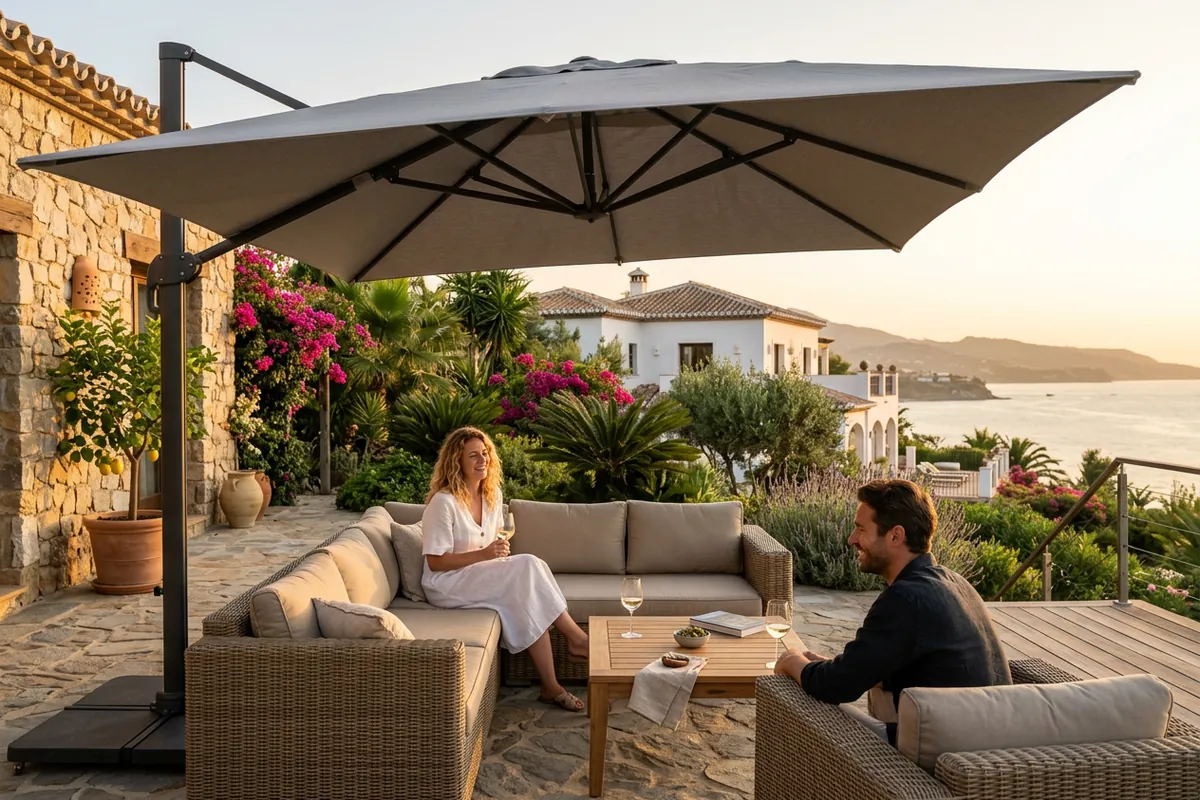
These are the gold standard for luxury villas in Málaga Este. By placing the heavy aluminum mast to the side, you gain 100% unobstructed space underneath. This is ideal for shading high-end outdoor kitchens (which typically cost between 4,000 EUR and 15,000 EUR) or premium sun loungers.
Advanced cantilever models feature multi-directional tilting mechanisms, allowing you to tilt the canopy vertically and horizontally to block the low-angled sun during late summer afternoons without moving the base. They also feature 360-degree rotation pedals, allowing a single parasol to shade a dining table at lunch and a poolside lounge area by the afternoon.
Center-Pole Parasols (Mástil Central)
For highly exposed locations, such as frontline beach properties in El Palo or elevated, wind-swept terraces in Cerro del Toril, center-pole parasols offer superior structural stability. The symmetrical distribution of weight and wind forces around the central mast makes them highly resilient against sudden Terral gusts. When paired with a heavy-duty granite or concrete base (ranging from 100kg to 150kg), these structures remain rock-solid.
Installation, Anchoring, and Wind Sensors
A large parasol is only as strong as its anchor point. In Málaga, where ground conditions vary from the sandy soils of Guadalmar to the steep, rocky terrains of Cerrado de Calderón, professional anchoring is non-negotiable.
Ground Anchoring Methods
- In-Ground Concrete Anchors (Anclaje Empotrado): The safest option for gardens and new-build terraces. We excavate a pit, pour a concrete footing, and submerge a steel ground sleeve flush with the tiles. The parasol mast bolts directly into this sleeve. This eliminates heavy, unsightly above-ground bases and provides maximum resistance against wind leverage.
- Heavy-Duty Mobile Bases: For finished terraces where drilling is not preferred, we utilize steel frame bases loaded with high-density concrete or granite slabs weighing between 120kg and 200kg. These bases often feature heavy-duty, lockable industrial casters to allow repositioning.
- Structural Wall Mounts: Ideal for narrow balconies or compact terraces in Teatinos. Heavy-duty steel brackets anchor the parasol arm directly into the structural concrete columns of the building, freeing up valuable floor space.
Smart Wind Protection: Wind Sensors and Motorization
For the ultimate peace of mind during a sudden Terral event, premium parasols can be integrated with home automation.
- Anemometers (Wind Sensors): A compact wind sensor mounted on the terrace roof or the parasol frame continuously monitors wind speeds. If gusts exceed a pre-set threshold (e.g., 45 km/h), the sensor triggers an integrated 24V or 230V motor to automatically fold and lock the parasol safely against the mast.
- Integrated LED Lighting and Heating: To transition your outdoor space from day to night, high-end parasols can be equipped with integrated dimmable LED strips along the ribs and short-wave infrared heaters, allowing you to enjoy your terrace comfortably during cooler winter evenings.
Regulations, Permits, and Community Guidelines in Málaga
Before purchasing or installing large shade structures, it is vital to understand the local legal framework managed by the Excmo. Ayuntamiento de Málaga through the Gerencia Municipal de Urbanismo, Obras e Infraestructuras (accessible via urbanismo.malaga.eu).
Private Property and the PGOU of Málaga
The current Plan General de Ordenación Urbana (PGOU) of Málaga simplified the traditional distinction between "obra menor" (minor works) and "obra mayor" (major works). It replaced this system with the Ordenanza de tramitación de licencias, categorizing interventions into Obras Tipo 1, 2 y 3.
- Toldos and Parasoles (Retractable or Mobile): Temporary, retractable, or mobile parasols and awnings installed within private property boundaries do NOT require a municipal license or formal declaration. They are considered temporary, demountable installations.
- Pérgolas, Glass Curtains, and Fixed Enclosures: If you plan to transition from a mobile parasol to a permanent structure—such as a bioclimatic pergola (typically costing 300 to 800 EUR/m2) or glass curtains (ranging from 300 to 500 EUR/m2)—you DO require a formal permit (Declaración Responsable or Licencia depending on the structural impact) accompanied by a qualified technical project.
Comunidad de Propietarios (HOA) Rules
If your home is part of a community of owners (comunidad de propietarios), particularly in modern apartment complexes in Teatinos-Universidad or residential estates in Cerrado de Calderón, any exterior installation that alters the aesthetic harmony of the facade (a common element under Spanish law) requires prior authorization from the community board. Always check the community statutes regarding approved fabric colors (often standardized to specific RAL tones) and maximum dimensions.
Coastal Public Domain (Ley de Costas)
For frontline beach properties, chiringuitos, and commercial venues along the extensive coastline (La Malagueta, Pedregalejo, El Palo, Guadalmar), installations are strictly regulated by the Demarcación de Costas (under state and regional management). The Ley de Costas establishes a servidumbre de protección (protection easement) of up to 100 meters and a servidumbre de tránsito (transit easement) of 6 meters in non-consolidated urban land. Permanent structures are strictly prohibited within these zones, making high-quality, heavy-duty mobile parasols the only legal option for providing shade.
Furthermore, properties located near the Montes de Málaga Natural Park or within historic conservation zones (BIC - Bienes de Interés Cultural) may face strict aesthetic guidelines regarding canopy colors, materials, and heights to preserve the natural and historical landscape.
Complementing Your Shade: Complete Outdoor Transformations
To truly maximize your outdoor living space in Málaga, a premium parasol is often integrated into a broader terrace or garden renovation. Here is a realistic cost guide for high-quality outdoor installations in the Málaga metropolitan area:
- Bioclimatic Pergolas: 300 EUR to 800 EUR per square meter. These aluminum structures feature motorized, tilting louvers that allow you to control sunlight and ventilation, providing a highly durable alternative to fabric parasols.
- Glass Curtains (Cerramientos de Cristal): 300 EUR to 500 EUR per square meter. Perfect for enclosing terraces in Teatinos, allowing year-round use while protecting outdoor furniture from coastal dust and rain.
- Custom Outdoor Kitchens: 4,000 EUR to 15,000 EUR+. These luxury installations are highly popular in El Limonar and Cerrado de Calderón villas, combining marine-grade stainless steel, built-in barbecues, and stone countertops.
- Artificial Grass Installation (Césped Artificial): 25 EUR to 60 EUR per square meter (including professional ground preparation, drainage, and high-density, UV-stabilized turf). This provides a lush, green, low-maintenance play and relaxation area underneath your shaded zones.
Delivery, Professional Assembly, and Maintenance in Málaga
A premium large-format parasol (ranging from 3x3 meters up to 5x5 meters or custom rectangular sizes) is a significant investment. To ensure its longevity, we manage the entire process from delivery to precision installation across Málaga capital.
Professional Installation Services
Our team handles the heavy lifting, structural calculations, and precision anchoring. Whether we are drilling into reinforced concrete slabs on a penthouse terrace in Teatinos or pouring deep concrete footings in a sloping garden in El Limonar, we ensure your shade structure is perfectly leveled, securely anchored, and fully calibrated to withstand the local wind profiles.
Essential Maintenance for Málaga's Environment
To keep your parasol looking and performing like new, we recommend a simple maintenance routine:
- Regular Rinsing: Hose down the fabric and frame with fresh water once every two weeks to wash away corrosive salt residues (salitre) and abrasive Saharan dust. Never use harsh chemical detergents; clean water and a soft brush are sufficient.
- Dry Before Closing: Always ensure the fabric is completely dry before folding and zipping it into its protective cover. Folding wet fabric can trap moisture, leading to mildew growth.
- Use Protective Covers: When the parasol is not in use, especially during the winter months or when you are away from your property, always secure it with a high-quality, UV-resistant protective storage sleeve.
- Winter Storage: For properties that remain vacant during parts of the winter, we recommend removing the parasol from its base and storing it in a dry, indoor garage or storage room to prolong its lifespan.
Why Buy From Us
Trusted Local Professionals
We connect you with vetted installers and specialists across the Costa del Sol — Estepona to Nerja.
Free, No-Obligation Quotes
Compare options and get a clear local price. No pressure, no guesswork.
Service in Your Language
Quotes and support in English, German, Dutch and French — every step.
We Live Here Too
We're expats ourselves. We understand your home because we know this coast — climate, salitre, permits.
Get Your Free Outdoor Living Quote
Tell us what you need. We respond within 2 hours with pricing and availability.
or message us directly
WhatsApp Us NowFrequently Asked Questions
How do I get a quote for parasols & shade sails in Málaga?
How much do parasols & shade sails cost in Málaga?
Do you cover Málaga?
Do I need a licence for parasols & shade sails in Málaga?
 JW'"
/>
JW'"
/>
Founder & Outdoor Living Specialist
Founder of Costa del Sol Outdoors. Outdoor & interior designer based in Estepona, helping expats create beautiful Mediterranean outdoor spaces with trusted local installers.