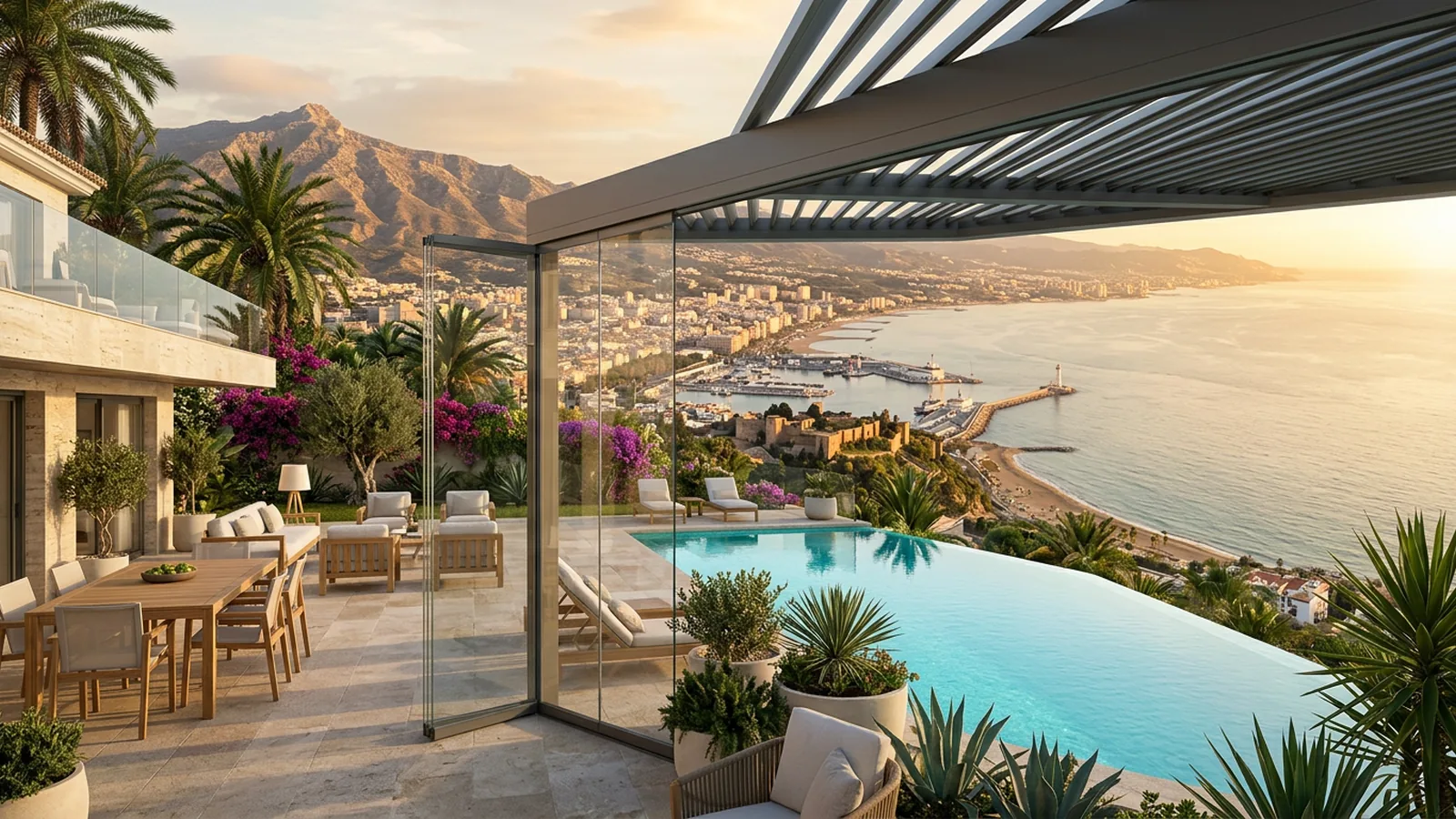
Swimming Pools in Málaga
Premium swimming pools for your Málaga home — designed and installed by trusted local pros. Free, no-obligation quotes.
Get Your Free QuoteSwimming Pool Construction, Renovation, and Maintenance in Málaga Capital
Building or maintaining a swimming pool in Málaga—the vibrant capital of the Málaga - Costa del Sol comarca—is a unique undertaking. As of January 1, 2024, the municipal padrón recorded a population of 593,333 inhabitants, which grew to 597,173 by January 1, 2025. This dynamic metropolis is home to a highly diverse international population. Unlike other municipalities on the coast like Marbella or Mijas, Málaga capital is not dominated by British expats. Instead, it is a global city home to 162 nationalities, with 71,177 foreign residents (comprising 57,917 non-EU and 13,260 EU citizens).
While the largest foreign demographics include Moroccan (10,568), Ukrainian (6,471), Colombian (5,580), and Paraguayan (5,489) residents, the premium property and pool installation market is heavily driven by affluent digital nomads, Italian (5,022), Northern European, and Russian (1,780) buyers. These high-net-worth residents settle predominantly in the exclusive hillside villa districts of Málaga Este—such as El Limonar, Cerrado de Calderón, Pedregalejo, El Palo, El Morlaco, and Cerro del Toril—as well as the modern, high-end apartment complexes of Teatinos-Universidad and Churriana.
For these homeowners, a private pool is the ultimate lifestyle asset. However, the coastal geography, microclimates, and strict local urban planning regulations require expert navigation.
Navigating Municipal Permits and Coastal Regulations in Málaga
Before breaking ground or starting a major pool renovation, you must navigate the regulatory framework of the Excmo. Ayuntamiento de Málaga, specifically managed through the Gerencia Municipal de Urbanismo (GMU), accessible online via urbanismo.malaga.eu.
The local Plan General de Ordenación Urbana (PGOU) of Málaga replaced the classic distinction between "obra menor" (minor works) and "obra mayor" (major works) with an streamlined licensing ordinance categorized into Obras Tipo 1, 2, and 3:
- Minor Interventions (Declaración Responsable / Comunicación Previa): Simple pool cosmetic updates, changing pool liners, or installing basic, non-structural equipment generally fall under this faster, prior-communication track.
- New Pool Construction and Structural Renovations (Licencia de Obra): Building a new inground concrete pool, installing a pre-fabricated fiberglass pool, or undertaking major structural alterations requires a formal building permit (Licencia), backed by a comprehensive technical project (proyecto técnico) signed by a registered architect or technical engineer.
- Coastal Protection Zones (Ley de Costas): Because Málaga is a coastal city stretching along the Mediterranean—encompassing beaches like La Malagueta, Pedregalejo, El Palo, and Guadalmar—any property situated near the shoreline is subject to the Spanish Coastal Law (Ley de Costas). This law enforces a protection easement (servidumbre de protección) of up to 100 meters and a transit easement (servidumbre de tránsito) of 6 meters in non-consolidated urban land. Any pool project within these zones requires additional authorization from the Demarcación de Costas (managed jointly by the State and the Junta de Andalucía).
- Special Protection Areas: If your property is located in the northern mountainous fringe bordering the Montes de Málaga Natural Park, or within designated historic conservation zones (BIC - Bienes de Interés Cultural), strict aesthetic and environmental conditions apply to pool designs, excavation, and landscaping.
- Community of Owners (Comunidades de Propietarios): If you live in a shared urbanization or apartment block in Teatinos or El Limonar, any exterior modification that affects the building's facade or common structural integrity (such as installing heavy rooftop plunge pools, glass curtains, or fixed pergolas) requires formal authorization from the homeowners' association (junta de propietarios).
Custom Swimming Pool Construction: Concrete vs. Fiberglass
Málaga’s geography ranges from the steep, rocky slopes of Málaga Este (Cerrado de Calderón and Cerro del Toril) to the flat, sandy alluvial soils of the Guadalhorce river delta in Churriana and Guadalmar. Choosing the right construction method is critical to ensuring your pool's longevity.
1. Gunite Concrete Pools (Piscinas de Hormigón Proyectado)
- Price Range: €30,000 to €45,000+ (depending on excavation complexity, access, and premium finishes).
- Best For: Hillside villas in El Limonar, Cerrado de Calderón, and Pedregalejo.
- Why Choose It: Gunite concrete offers total design freedom, allowing for infinity edges (borde infinito) that maximize panoramic views of the Bay of Málaga. Because these properties are built on steep terrain, concrete pools can be structurally engineered with retaining walls and deep pilings to anchor the pool safely into the hillside.
- Finishes: Premium glass mosaic tiles (gresite) in deep blues, emerald greens, or modern light grey stone finishes are highly popular among international buyers.
2. Pre-fabricated Fiberglass Pools (Piscinas de Poliéster/Fibra)
- Price Range: €20,000 to €30,000.
- Best For: Flat plots in Churriana, Guadalmar, and inland residential pockets.
- Why Choose It: Fiberglass pools are much faster to install, taking only 1 to 2 weeks once excavation is complete. They offer a smooth, non-porous surface that resists algae growth and requires fewer chemicals. However, access is a key constraint; transporting a massive one-piece fiberglass shell through the narrow, winding streets of historic Pedregalejo or steep lanes of El Morlaco can be physically impossible, making concrete the default choice for those areas.
Pool Renovation, Leak Detection, and Saltwater Conversions
Many older villas in urbanizations built in the 1980s and 1990s require modernization. The most common renovation requests in Málaga include:
Structural Leak Repair and Re-lining
Málaga’s seismic activity and soil shifting (especially on clay-heavy hillside slopes) can cause structural cracks in older concrete pools. We utilize advanced pressure testing and electro-acoustic leak detection to pinpoint underground pipe failures or structural fissures. For compromised pools, installing a reinforced PVC membrane (lámina armada or liner) is a highly effective, 100% waterproof solution that flexes with ground movement, preventing future leaks.
Saltwater Chlorination Upgrades (Cloración Salina)
Traditional chlorine pools are rapidly being phased out in favor of saltwater systems. Saltwater chlorination uses electrolysis to convert natural salt into a mild, self-regenerating sanitizer. It is gentler on the eyes, skin, and hair, and eliminates the harsh chemical smell. For the international expat community accustomed to premium wellness standards, saltwater systems—often paired with automated pH and chlorine dosing pumps—are considered an essential upgrade.
The Coastal Challenge: Salitre, Terral, and Material Selection
Málaga’s coastal environment presents harsh atmospheric conditions that pool builders and outdoor living installers must design around:
Marine-Grade Salitre Protection
The high level of airborne salt (salitre) along the Málaga coastline causes rapid corrosion of standard metals. Any metal component installed near the pool—including pool ladders, handrails, outdoor shower fixtures, and structural fasteners—must be made of marine-grade AISI 316 stainless steel.
For pool surrounds and adjacent structures like pergolas or outdoor kitchens, we utilize marine-grade powder-coated aluminum. Standard steel or low-grade aluminum will oxidize and pit within a few seasons of exposure to the salty sea breeze.
Wind Resistance: The Terral and the Levante
Málaga is famous for its intense wind patterns: the hot, dry Terral blowing from the interior, and the humid Levante blowing in from the east. These winds can carry significant dust, debris, and Saharan sand (calima), which rapidly dirty pools and put immense physical strain on outdoor structures.
- Awnings and Toldos: Standard awnings can easily tear or warp under these wind loads. We install awnings rated to Clase 6 under the UNE-EN 13659 standard, which are engineered to withstand wind speeds of up to approximately 175 km/h. Motorized awnings (ranging from €150 to €450 per square meter) should always be integrated with automated wind sensors (anemómetros) that automatically retract the fabric when wind speeds exceed safe limits.
- Pergolas: Fixed aluminum bioclimatic pergolas (ranging from €250 to €600 per square meter) feature adjustable motorized louvers that can be opened slightly to allow wind to pass through, reducing the uplift force during heavy Levante gusts.
Pool Heating and Year-Round Usability
While Málaga boasts over 320 sunny days a year, unheated pool water is generally too cold for comfortable swimming from late October to early May. To maximize your investment and cater to digital nomads and expats who reside in Málaga year-round, heating is highly recommended.
- Inverter Heat Pumps: The most energy-efficient way to heat a pool in Málaga is an air-source inverter heat pump. By extracting heat from our warm Mediterranean air, these systems deliver up to 5 to 6 times the electrical energy they consume in heating power.
- Thermal Covers: An automated slatted pool cover or a heavy-duty bubble cover is essential when heating a pool. Without it, up to 70% of the heat is lost overnight through evaporation, especially when the cool night winds roll down from the Montes de Málaga.
- Solar Heating: Utilizing Málaga's abundant sunshine via roof-mounted solar thermal collectors is a highly sustainable option, often used in tandem with a heat pump to keep heating costs near zero during the shoulder seasons.
Professional Pool Maintenance in Málaga
Proper pool maintenance in Málaga requires a consistent schedule, particularly during the blistering summer months when high bather loads and intense UV radiation rapidly deplete sanitizers.
| Parameter | Recommended Target Range | Frequency of Testing |
|---|---|---|
| pH Level | 7.2 – 7.6 | Twice weekly in summer / Weekly in winter |
| Free Chlorine | 1.0 – 3.0 ppm (parts per million) | Twice weekly in summer / Weekly in winter |
| Salt Concentration | 4,000 – 5,000 ppm (subject to chlorinator specs) | Monthly |
| Cyanuric Acid (Stabilizer) | 30 – 50 ppm | Monthly |
| Alkalinity | 80 – 120 ppm | Monthly |
Seasonal Maintenance Tasks
- Summer (May to September): Daily filtration runs of 8 to 12 hours to combat high temperatures. Daily skimming of leaves and debris, especially in leafy areas near the Montes de Málaga or mature gardens in El Limonar.
- Winter (October to April): If not heating the pool, the system can be transitioned to "hibernation" mode. This involves lowering filtration to 2 to 3 hours daily, applying a winterizing chemical (invernador) to prevent algae, and covering the pool to shield it from dirt and reduce evaporation.
- Post-Calima Cleanup: When a mud-rain (calima) event occurs, do not run the pool vacuum through the main filtration system immediately, as the ultra-fine clay dust will clog the sand filter. Instead, flocculate the pool to bind the dust particles, let them settle to the floor, and vacuum them directly to "waste" (desagüe).
Why Buy From Us
Trusted Local Professionals
We connect you with vetted installers and specialists across the Costa del Sol — Estepona to Nerja.
Free, No-Obligation Quotes
Compare options and get a clear local price. No pressure, no guesswork.
Service in Your Language
Quotes and support in English, German, Dutch and French — every step.
We Live Here Too
We're expats ourselves. We understand your home because we know this coast — climate, salitre, permits.
Get Your Free Outdoor Living Quote
Tell us what you need. We respond within 2 hours with pricing and availability.
or message us directly
WhatsApp Us NowFrequently Asked Questions
How do I get a quote for swimming pools in Málaga?
How much do swimming pools cost in Málaga?
Do you cover Málaga?
Do I need a licence for swimming pools in Málaga?
 JW'"
/>
JW'"
/>
Founder & Outdoor Living Specialist
Founder of Costa del Sol Outdoors. Outdoor & interior designer based in Estepona, helping expats create beautiful Mediterranean outdoor spaces with trusted local installers.