Kamado BBQs in Estepona
Premium kamado bbqs for your Estepona home — designed and installed by trusted local pros. Free, no-obligation quotes.
Get Your Free QuoteBarbacoas Kamado Cerámicas in Estepona: The Ultimate Guide to Ceramic Grilling on the Costa del Sol
For homeowners along the sun-drenched stretches of Estepona, outdoor living is not merely a seasonal luxury; it is a year-round lifestyle. With the municipal census (el padrón) recording around 72,000 registered residents representing over 120 nationalities, and the latest 2025 INE (Censo Anual de Población) figures showing the actual population has surged to 79,621 inhabitants, Estepona has evolved into one of the most dynamic, multicultural hubs of the Costa del Sol Occidental. More than 25% to 30% of these residents are foreign expats, led by a large British community of approximately 4,615 registered individuals, alongside significant populations of Moroccan, Russian (around 942), German (around 835), Dutch (around 586), and Argentine nationals.
This affluent, international demographic has fueled a high-end real estate boom, particularly along the New Golden Mile (Nueva Milla de Oro), El Paraíso, Cancelada, Atalaya, Benavista, Bel-Air, Costalita, El Presidente, Selwo, Saladillo-Benamara, Bahía Dorada, and the ultra-exclusive Los Flamingos Golf (home to the iconic Villa Padierna). In these premium developments, luxury villas with expansive gardens and high-end coastal apartments dominate.
For these properties, a standard metal barbecue simply will not suffice. The discerning homeowner demands culinary versatility, architectural integration, and materials capable of surviving Estepona's unique coastal microclimate. This is why the barbacoa kamado cerámica (ceramic kamado BBQ) has become the ultimate status symbol and culinary tool for Estepona’s outdoor kitchens.
Why the Kamado Ceramic BBQ is Perfect for Estepona's Microclimate
Estepona boasts a privileged geography. Spanning 137 square kilometers with 23 kilometers of Mediterranean coastline, the municipality is dominated to the north by the majestic Sierra Bermeja. Rising to 1,449 meters at the peak of Los Reales, this striking red-soil mountain range acts as a protective shield, blocking cold northern winds and creating a unique microclimate characterized by over 320 days of sunshine a year and approximately 2,900 hours of annual sunlight.
However, this microclimate also presents severe environmental challenges for outdoor cooking equipment:
- Extreme Salitre (Salt-Air Corrosion): Properties in frontline beach urbanizations like Costalita, Bahía Dorada, and Villacana experience relentless marine salinity. Standard steel barbecues rust, flake, and fail within two seasons. The high-fire glazed ceramic shell of a premium kamado is completely impervious to salt air, while its metal fittings must be upgraded to marine-grade stainless steel (316 grade) or powder-coated cast aluminum to withstand the coastal air.
- Intense UV Radiation: With summer highs reaching 30°C and a UV index soaring to 9 or 10+ in July and August, materials like plastics, low-grade rubbers, and cheap wood handles degrade rapidly. The heavy-duty glazed ceramic of a kamado reflects heat and resists UV fading, ensuring the exterior looks pristine for decades.
- The Battle of the Winds: Levante and Poniente: Estepona is constantly influenced by the Levante (easterly) and Poniente (westerly) winds. The Levante wind often pushes moisture against Sierra Bermeja, leaving a crown of clouds over the peaks while driving warm, humid air across the coast. The Poniente brings dry, hot air from the interior. Traditional open grills struggle to maintain consistent temperatures under these gusty conditions. A ceramic kamado, with its airtight seal, heavy thermal mass, and precise top and bottom ventilation dampers, remains completely unaffected by wind gusts, holding its internal temperature steady whether you are grilling at 350°C or slow-smoking at 110°C.
The Anatomy of a Ceramic Kamado: Versatility for International Palates
The international expat profile in Estepona demands culinary versatility. British residents love their traditional Sunday roasts; German, Dutch, and Belgian homeowners appreciate precise, high-temperature grilling; while Scandinavian and Russian residents often look for slow-smoking capabilities for fish and meats.
The ceramic kamado excels at all of these due to its egg-shaped design and thick, heat-retaining ceramic walls:
- The Ceramic Core: Made from high-grade refractory ceramics or cordierite, the body insulates the charcoal fire, requiring up to 75% less charcoal than a standard open metal grill. This insulation retains moisture, ensuring that meats cooked under the Estepona sun do not dry out.
- The Airflow System: By adjusting the bottom draft door and the top daisy-wheel chimney, you control the oxygen flow. This allows you to transition from low-and-slow smoking (ideal for a 12-hour pork shoulder) to high-heat searing (perfect for Argentine ribeyes or fresh Mediterranean sea bass sourced from Estepona's fishing port).
- The Deflector Plates: By inserting ceramic heat deflector stones, you transform the kamado from a direct-flame grill into an indirect convection oven. This is how you bake artisan sourdough bread, roast whole chickens, or cook authentic stone-baked pizzas at 400°C.
Integrating a Kamado into Estepona Outdoor Kitchens
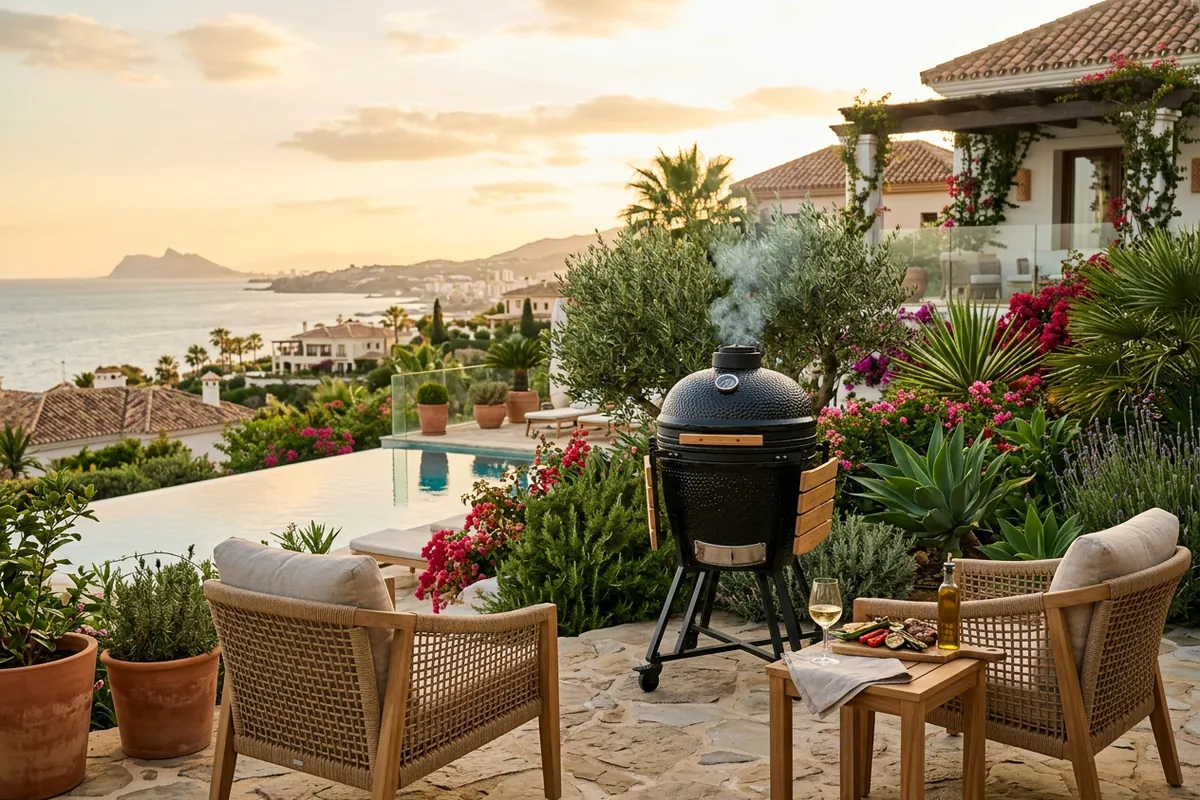
In the luxury villas of El Paraíso, Los Flamingos, and the New Golden Mile, the kamado is rarely used as a standalone unit on a rolling cart. Instead, it is integrated into custom-designed outdoor kitchens (cocinas de exterior).
When planning an outdoor kitchen installation in Estepona, several structural and material factors must be considered:
- Premium Outdoor Kitchen Construction (Budget: 4,000 to 15,000 EUR): To withstand the high humidity, salt air, and intense summer heat, the kitchen structure should be built using marine-grade aluminum frames, concrete blocks finished with microcement, or high-density polymer boards. Worktops should be made of ultra-compact sintered stone (such as Dekton or Neolith), which is completely UV-resistant, scratch-proof, and impervious to hot kamado grates.
- Kamado Placement and Ventilation: A ceramic kamado can weigh anywhere from 80 kg to over 140 kg (for XL models). The outdoor kitchen counter must be structurally reinforced to support this concentrated weight. Furthermore, the kamado must sit on a specialized ceramic feet set or a heavy-duty metal table nest to elevate its hot bottom base off the countertop material, preventing heat transfer and cracking.
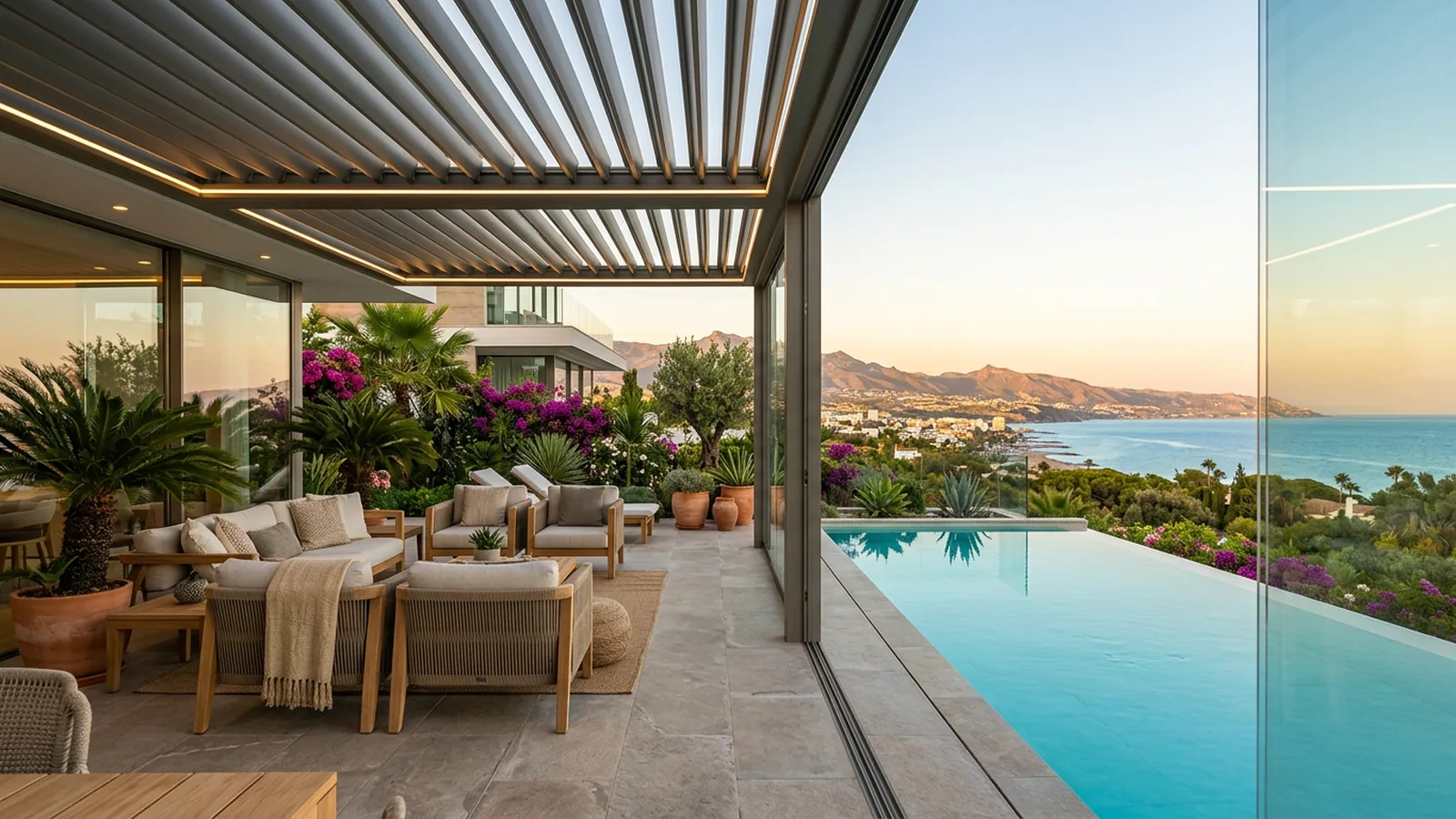
- Wind and Shade Structures: To protect the chef from the intense UV index of 10+ and sudden Levante gusts, outdoor kitchens are frequently paired with bioclimatic pergolas (typically costing 300 to 800 EUR/m²). If you are installing a pergola, ensure it features wind sensors that automatically adjust the louvers or retract screens when winds exceed safe limits. For coastal properties, structures should comply with Class 6 UNE-EN 13659 standards, resisting winds up to 175 km/h.
- Glass Curtains (Cortinas de Cristal - Budget: 300 to 500 EUR/m²): For semi-enclosed terrace installations in apartments along Costalita or Bahía Dorada, glass curtains allow you to enjoy your outdoor dining space during the winter months. However, if you plan to use a charcoal kamado within a semi-enclosed terrace, you must ensure adequate ventilation or install a professional-grade stainless steel extractor hood to safely vent carbon monoxide and smoke.
Navigating Local Regulations, Permits, and Community Rules in Estepona
Installing an outdoor kitchen and a premium ceramic kamado in Estepona requires navigating specific municipal, community, and environmental regulations.
1. Ayuntamiento de Estepona Permits
The Ilmo. Ayuntamiento de la Villa de Estepona regulates all construction through its municipal planning department (PGOU). The town hall has approved a streamlined municipal licensing ordinance (Ordenanza Municipal Reguladora de Licencias) that simplifies the process:
- Obra Menor (Minor Works): Simple outdoor kitchen installations, tiling, and the placement of non-structural pergolas or awnings fall under the obra menor category. For simplified procedures on urban land that do not alter the building's exterior volume, structure, or designated use, you can submit a declaración responsable (responsible declaration) or comunicación previa. Work can legally begin 15 days after submission if no objections or requests for clarification are issued by the town hall.
- Obra Mayor (Major Works): If your outdoor kitchen project involves structural changes, extending a concrete roof, closing a terrace permanently, or building a heavy brick pavilion that adds to the property's built volume, you must apply for an obra mayor license, which requires a project signed by an architect and takes longer to approve.
2. The Coastal Law (Ley de Costas)
If your villa or apartment complex is located on the frontline beach (such as properties in Bahía Dorada, Costalita, or Villacana), you are subject to the national Ley de Costas. This law establishes a protection easement zone (servidumbre de protección) extending up to 100 meters inland from the maritime-terrestrial public domain (which can be reduced to 20 meters in consolidated urban land).
- Within this zone, permanent, closed structural additions are strictly prohibited.
- Any outdoor kitchen or kamado station built here must consist of removable, non-permanent installations (such as modular aluminum kitchens and freestanding pergolas) to avoid severe fines and demolition orders.
3. Community of Owners (Comunidad de Propietarios)
In Estepona's luxury developments and apartment complexes, the community statutes (estatutos de la comunidad) are highly restrictive.
- Before installing an outdoor kitchen, glass curtains, or fixed pergolas on your terrace or private garden, you must obtain formal approval from the community administration.
- While a freestanding ceramic kamado does not require permission, the smoke generated during the initial lighting phase of charcoal can occasionally disturb neighbors. Using high-quality, sustainably sourced lump charcoal (such as Holm Oak / Encina) minimizes smoke and ensures compliance with community cohabitation rules.
4. Environmental Protected Zones
To the north of the municipality lies the protected natural area of Sierra Bermeja / Los Reales, famous for its rare pinsapo (Spanish fir) forest. If your property is located on rustic, non-urbanizable land near the foothills of the sierra (such as parts of El Padrón or El Velerín), strict fire prevention laws apply. During the high-risk forest fire season (typically from June 1st to October 15th), open fires and traditional charcoal barbecues are strictly prohibited in rustic zones. However, in urbanized residential zones (suelo urbano), charcoal cooking is permitted, provided common-sense safety measures are taken.
Delivery, Installation, and Professional Local Service in Estepona
A ceramic kamado is a precision instrument, but it is also incredibly heavy and fragile before it is fully assembled. A large or extra-large kamado can easily weigh over 100 kg, and its internal firebox components are made of unglazed ceramic plates that can crack if mishandled.
For our clients across Estepona—from the steep hillsides of Los Flamingos to the beachfront penthouses of the New Golden Mile—we provide a specialized, stress-free local installation and installation service:
- Safe Transport & Delivery: We handle the logistics of moving these heavy ceramic units. Whether your property has narrow stairs, steep driveways in El Paraíso, or requires elevator access in a beachfront complex, our team arrives with the specialized equipment needed to transport the kamado safely.
- Professional Assembly: We assemble the delicate internal firebox, align the heavy-duty spring-assisted hinge, mount the dual-disc top vent, and securely position the kamado into your custom outdoor kitchen counter or rolling cart.
- First Burn & Calibration: We don't just drop off the box. Our expert installers will perform the initial setup, explain how to manage the air dampers for precise temperature control, and recommend the best local fuels. For the Costa del Sol, we highly recommend premium Spanish carbón de encina (holm oak charcoal), which burns incredibly hot, lasts for hours, and imparts a classic Mediterranean wood-fired flavor to your dishes.
Investing in a premium barbacoa kamado cerámica is the perfect way to elevate your outdoor culinary experience while complementing the luxury lifestyle of Estepona. Whether you are hosting a summer pool party in Atalaya, roasting a festive dinner in El Paraíso, or enjoying a quiet sunset meal on your Costalita terrace, the kamado delivers unmatched performance, durability, and style in any weather.
Why Buy From Us
Trusted Local Professionals
We connect you with vetted installers and specialists across the Costa del Sol — Estepona to Nerja.
Free, No-Obligation Quotes
Compare options and get a clear local price. No pressure, no guesswork.
Service in Your Language
Quotes and support in English, German, Dutch and French — every step.
We Live Here Too
We're expats ourselves. We understand your home because we know this coast — climate, salitre, permits.
Get Your Free Outdoor Living Quote
Tell us what you need. We respond within 2 hours with pricing and availability.
or message us directly
WhatsApp Us NowFrequently Asked Questions
How do I get a quote for kamado bbqs in Estepona?
How much do kamado bbqs cost in Estepona?
Do you cover Estepona?
Do I need a licence for kamado bbqs in Estepona?
 JW'"
/>
JW'"
/>
Founder & Outdoor Living Specialist
Founder of Costa del Sol Outdoors. Outdoor & interior designer based in Estepona, helping expats create beautiful Mediterranean outdoor spaces with trusted local installers.