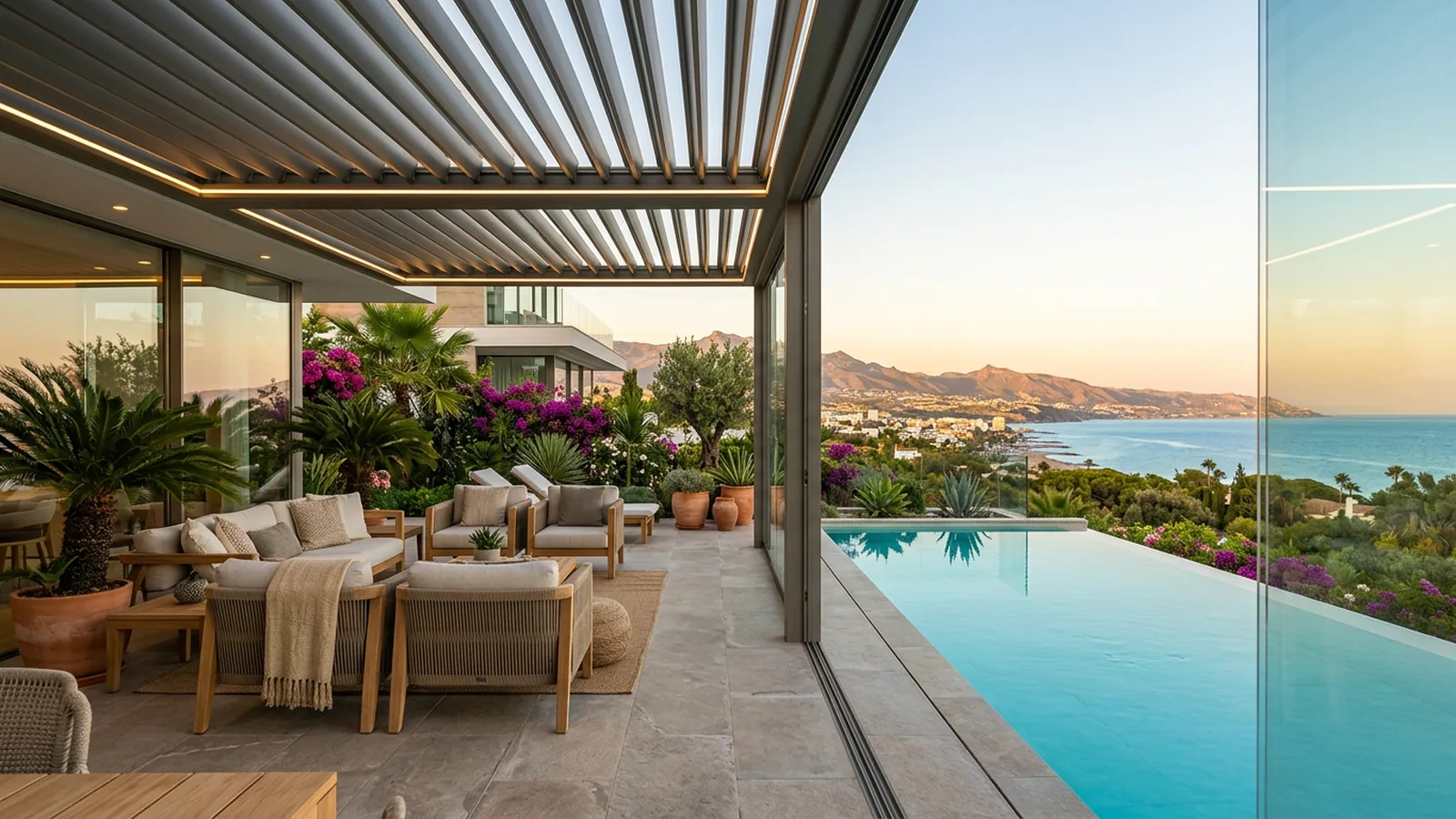
Shade Sails in Estepona
Premium shade sails for your Estepona home — designed and installed by trusted local pros. Free, no-obligation quotes.
Get Your Free QuoteVelas de Sombra in Estepona: Premium Tensioned Shade Sails for the New Golden Mile and Beyond
Estepona has undergone a remarkable transformation. No longer just a quiet fishing port, this vibrant municipality in the Costa del Sol Occidental now spans 137 square kilometres with 23 kilometres of Mediterranean coastline. According to the 2025 INE (Censo Anual de Población), Estepona's population has surged to 79,621 residents, while the local municipal register (el padrón) records around 72,000 registered inhabitants representing over 120 nationalities. More than 25% to 30% of these registered residents are foreign nationals. British expats form the largest international community with approximately 4,615 registered individuals, followed closely by Moroccan, Russian (around 942), German (around 835), Dutch (around 586), and Argentine citizens.
This diverse, high-net-worth demographic has fuelled a premium real estate market. High-end developments stretch across the famous New Golden Mile (Nueva Milla de Oro), El Paraíso, Cancelada, Atalaya, Benavista, Bel-Air, Costalita, El Presidente, Selwo, Saladillo-Benamara, and the exclusive enclave of Los Flamingos Golf near the Villa Padierna resort. Here, luxury villas with expansive gardens and modern architectural lines dominate the landscape.
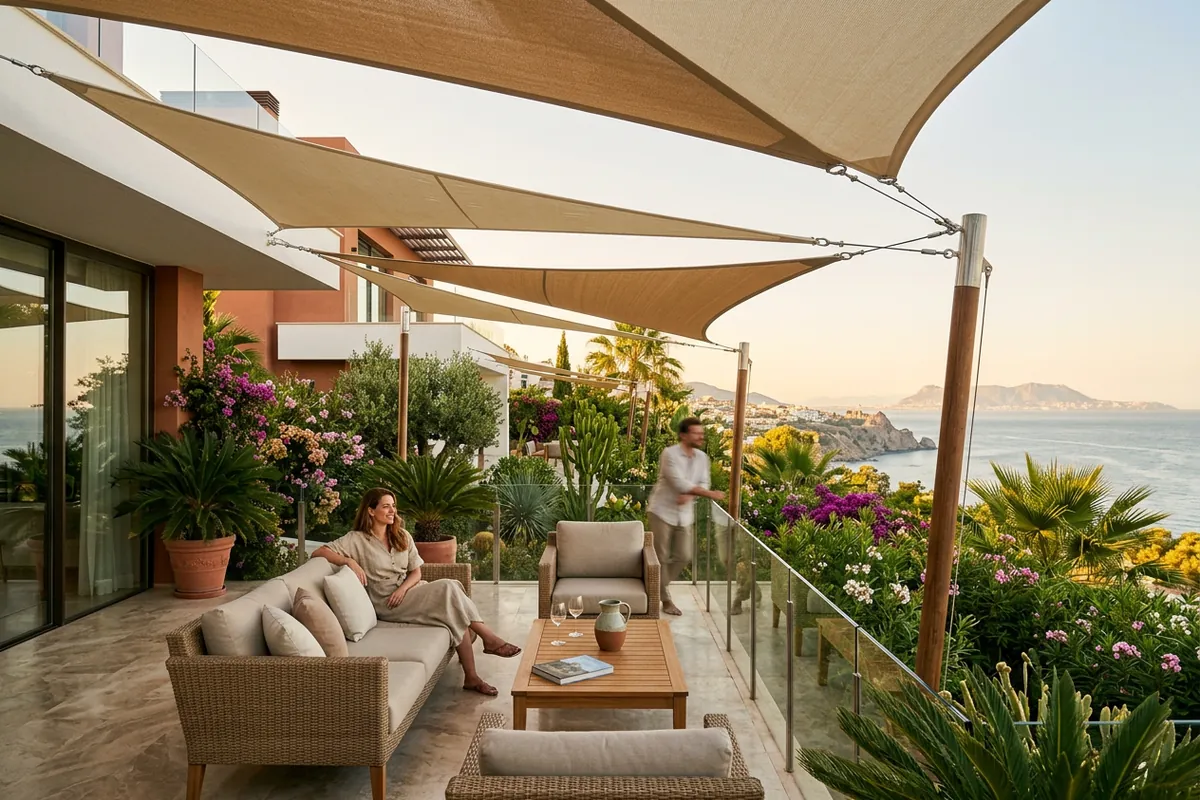
For these premium properties, standard off-the-shelf umbrellas or basic awnings simply do not suffice. High-end tensioned shade sails (velas de sombra), supplied and professionally installed, have become the architectural shade solution of choice. They complement the clean lines of contemporary Andalusian villas while offering robust, engineered protection against the microclimate of the region.
The Estepona Microclimate: Wind, Sun, and Salt-Air Engineering
Designing and installing a tensioned shade sail in Estepona requires a deep understanding of the local geography. The municipality is bordered to the north by the striking Sierra Bermeja mountain range, which rises to 1,449 metres at the pico de Los Reales. This red-tinted peridotite mountain range acts as a protective barrier, shielding the coastal strip from cold northern winds and creating a unique microclimate.
However, this geography also dictates specific weather patterns that directly affect outdoor installations:
- Extreme Solar Radiation: Estepona enjoys over 320 days of sunshine a year, translating to roughly 2,900 sun hours annually. During July and August, the UV index regularly hits 9 to 10+. This intense radiation rapidly degrades standard fabrics, causing them to fade, stretch, and lose structural integrity within a couple of seasons.
- The Wind Dynamics (Levante vs. Poniente): The coast is subject to two dominant winds. The Poniente (from the west) is generally warm and dry. The Levante (from the east) brings humid air from the Mediterranean, often creating a characteristic crown of clouds over Sierra Bermeja. When these winds pick up, they can funnel through coastal valleys and riverbeds—such as the Padrón, Velerín, Castor, Monterroso, Guadalobón, Guadalmansa, and Guadalmina rivers.
- High Salinity (Salitre): Properties in frontline beach developments like Costalita, Bahía Dorada, and Playa del Sol-Villacana are exposed to constant salt-laden sea breezes. This salt-air environment accelerates the corrosion of inferior metals.
Structural Implications for Shade Sails
To withstand these conditions, professional shade sail installations in Estepona must adhere to strict marine-grade engineering standards:
- Marine-Grade Hardware (316 Stainless Steel): All turnbuckles, pad eyes, shackles, and tensioning chains must be manufactured from AISI 316 stainless steel. Standard 304 stainless or galvanized steel will tea-stain and rust within months due to the high salitre levels.
- Heavy-Duty Support Posts: Posts must be constructed from structural steel (hot-dip galvanized and powder-coated) or marine-grade structural aluminium. They must be engineered to resist deflection under high wind loads.
- Wind-Resistance Standards: Sails should be engineered to withstand the sudden gusts common to the Costa del Sol. High-end installations are designed to meet Classe 6 wind resistance under the UNE-EN 13659 standard, capable of enduring winds up to 175 km/h when properly tensioned and anchored.
- High-Density Polyethylene (HDPE) Monofilament Fabrics: Premium sails utilize commercial-grade HDPE mesh (such as Commercial 95 or Galebreaker fabrics) weighing between 320g/m2 and 430g/m2. These fabrics block up to 95-98% of harmful UV rays, are highly breathable (allowing hot air to escape upwards), and do not rot or absorb moisture. For 100% waterproof requirements, high-tensile PVC-coated polyesters (such as Serge Ferrari Soltis) are used, though these require steeper installation angles to prevent water pooling.
- Dual-Axis Curvature (Hypar Designs): Flat, horizontal sails are a recipe for disaster in Estepona. Professional installers design sails with a three-dimensional twist (hyperbolic paraboloid or "hypar" shape) by varying the heights of the attachment points. This tensioning technique prevents the sail from flapping violently in the Levante wind and ensures rainwater sheds efficiently.
Navigating Local Regulations: Town Hall and Community Approvals
Installing a permanent or semi-permanent structure in Estepona requires compliance with local municipal ordinances, coastal laws, and community bylaws.
Ayuntamiento de Estepona (Municipal Permits)
The Ayuntamiento de Estepona (Ilmo. Ayuntamiento de la Villa de Estepona) operates under a municipal planning framework (PGOU). The town hall has approved a Municipal Licensing Ordinance (Ordenanza Municipal Reguladora de Licencias) that clearly distinguishes between:
- Obra Mayor (Major Works): Projects of high complexity, larger budgets, or those that alter the volume, structural footprint, height, or primary use of the property. These require a formal project signed by an architect and can take several months to approve.
- Obra Menor (Minor Works): Projects of simple technical execution, limited budget, and those that do not alter the structural volume or exterior composition of the building.
For tensioned shade sails, pergolas, and awnings that do not involve permanent brick-and-mortar enclosures, the process is typically treated as an obra menor via a simplified procedure (declaración responsable or comunicación previa). In urban zones, if the installation does not affect the load-bearing structure of the main building or increase the habitable volume, work can technically begin 15 days after submitting the application and paying the corresponding municipal taxes, provided no objections or requests for clarification are issued by the planning department.
Ley de Costas (The Spanish Coastal Law)
For frontline beach properties in developments like Bahía Dorada, Costalita, or El Velerín, the Spanish Coastal Law (Ley de Costas) applies. The coastal strip is subject to:
- Servidumbre de Protección (Protection Easement): Spans up to 100 metres inland from the maritime-terrestrial public domain (reducible to 20 metres in consolidated urban land).
- Servidumbre de Tránsito (Transit Easement): A 6-metre strip directly adjacent to the sea that must remain completely clear for pedestrian and rescue access.
Permanent, closed structures are strictly prohibited within these zones. Tensioned shade sails are highly favoured here because they are classified as demountable, non-permanent installations, making them far easier to justify and approve under coastal protection guidelines than concrete porches or heavy wooden pergolas.
Protected Natural Zones
To the north of the municipality lies the Sierra Bermeja / Los Reales Natural Area (Paraje Natural), famous for its unique pinsapo (Spanish fir) forest. If your property borders this northern rustic land (suelo no urbanizable protegido), strict environmental regulations prevent any form of construction or alteration of the landscape. Shade sails installed here must use natural, earthy tones (terracottas, sands, and stone greys) to blend seamlessly with the natural environment, and permanent concrete footings may be restricted in favour of removable ground-screw anchors.
Comunidad de Propietarios (HOA)
If your villa or apartment is part of a community of owners (Comunidad de Propietarios), the community statutes (Estatutos) almost always regulate the aesthetic harmony of the complex. Before installing a shade sail on a terrace in Costalita or a garden in El Paraíso, you must obtain written approval from the community administration. This ensures the chosen fabric colour and post design align with the community's established aesthetic guidelines for awnings, glass curtains, and exterior structures.
Designing for the Estepona Expat Lifestyle
The typical buyer profile in Estepona’s premium zones—such as the New Golden Mile, Los Flamingos, and Atalaya—consists of high-net-worth individuals from the UK, Scandinavia, Germany, the Netherlands, Belgium, and Russia. These homeowners expect seamless indoor-outdoor living spaces that function as natural extensions of their luxury villas.
To achieve this, shade sails are rarely installed in isolation. They are integrated into comprehensive outdoor living designs that include:
- Bioclimatic Pergolas: Often used over main dining areas, costing between 300 EUR and 800 EUR per square metre depending on motorization and integrated LED lighting.
- Glass Curtains (Cortinas de Cristal): Essential for enclosing terraces during the cooler winter months or windy Levante days, priced between 300 EUR and 500 EUR per square metre.
- Outdoor Kitchens: High-end bespoke BBQ and preparation areas, ranging from 4,000 EUR to 15,000 EUR depending on appliances and stone worktops.
- Artificial Grass (Césped Artificial): Premium, UV-stabilized turf installations suitable for the dry climate, costing between 25 EUR and 60 EUR per square metre (fully installed).
A custom-designed tensioned shade sail acts as the perfect architectural canopy to shield these valuable outdoor investments from the intense Estepona sun, preventing the fading of outdoor kitchen materials, the overheating of glass-enclosed terraces, and the degradation of luxury outdoor furniture.
Professional Installation vs. DIY: Why Tension Matters
Many homeowners are tempted by cheap shade sails sold online. However, in a coastal environment like Estepona, a DIY installation often leads to structural failure. Here is why professional installation is essential:
| Feature | Professional Engineered Installation | DIY / Retail Grade |
|---|---|---|
| Fabric Quality | Commercial-grade HDPE (320g/m2+) or PVC, UV-stabilized for 10+ years. | Lightweight polyester or low-grade HDPE (under 180g/m2), fades in 1-2 seasons. |
| Hardware | AISI 316 Marine-grade stainless steel with heavy-duty turnbuckles. | 304 Stainless or zinc-plated steel, prone to rapid rust from salitre. |
| Structural Posts | Engineered galvanized/powder-coated steel or structural aluminium. | Thin-walled steel or wooden posts that bend under high wind loads. |
| Tensioning Force | High-tension winches apply up to 100-150 kg of radial tension per corner. | Hand-tensioned, leading to sagging, water pooling, and violent flapping. |
| Wind Resistance | Designed to withstand up to 175 km/h (Classe 6 UNE-EN 13659). | Must be taken down in moderate breezes to prevent tearing. |
| Foundations | Deep concrete footings (typically 80x80x100cm) calculated for soil type. | Shallow footings or direct bolting to thin terrace tiles, risking structural uplift. |
The Importance of Tension
A loose shade sail is a dangerous sail. When the Levante wind blows down from Sierra Bermeja, a loose sail acts like a giant kite, exerting immense upward and lateral force on its anchor points. This constant movement causes metal fatigue in the brackets and can easily rip rawlplugs out of villa walls or pull down weak brick pillars.
Professional installers use specialized tensioning equipment to pull the sail incredibly taut. When fully tensioned, the sail behaves like a rigid drum skin. The wind flows smoothly over and under the curved surfaces rather than catching the fabric, drastically reducing the load transferred to the building's structure.
Step-by-Step Installation Process in Estepona
When you contract a professional installation on the Costa del Sol, the process follows a precise engineering and design workflow:
- Site Assessment and Sun Mapping: The installer visits your property in areas like El Paraíso or Cancelada to assess the orientation. Using 3D sun-mapping software, they calculate the exact angle of the sun throughout the summer months to ensure the shadow falls precisely where you need it (e.g., over your outdoor dining table or pool loungers) during peak heat hours (13:00 to 17:00).
- Structural Integrity Check: The installer examines the villa's walls. Modern villas on the New Golden Mile often use hollow brick (ladrillo hueco) or external thermal insulation systems (SATE). Anchoring directly into these requires specialized chemical anchors (resina epoxi) and long threaded studs that reach the inner concrete core or structural columns.
- Foundation Pouring: For free-standing posts, holes are excavated (often through existing gardens or terraces). Given Estepona's coastal soil profile, which can range from sandy soils near Costalita to clay-heavy soils near Selwo, footings must be sized correctly—typically requiring a minimum of 0.5 to 1 cubic metre of concrete per post to resist overturning moments.
- Post Installation and Measurement: Once the posts and wall brackets are securely in place, precise laser measurements are taken from point to point. Premium sails are never pre-made; they are custom-patterned to the exact millimetre of the finished hardware layout to ensure perfect tensioning.
- Sail Fabrication: The sail is stitched using UV-resistant PTFE thread (such as Tenara), which does not degrade in the sun. The perimeter of the sail is reinforced with a heavy-duty stainless steel wire cable (cable de acero inoxidable) encased in a double-locked hem. This cable transfers the tension from the corners along the entire edge of the sail, preventing sag.
- Final Tensioning and Handover: The sail is hung using 316 stainless steel turnbuckles and tensioned to the engineered specification. The installer will demonstrate how to easily de-tension and remove the sail using quick-release shackles if you plan to close up your second residence during the winter months.
Why Buy From Us
Trusted Local Professionals
We connect you with vetted installers and specialists across the Costa del Sol — Estepona to Nerja.
Free, No-Obligation Quotes
Compare options and get a clear local price. No pressure, no guesswork.
Service in Your Language
Quotes and support in English, German, Dutch and French — every step.
We Live Here Too
We're expats ourselves. We understand your home because we know this coast — climate, salitre, permits.
Get Your Free Outdoor Living Quote
Tell us what you need. We respond within 2 hours with pricing and availability.
or message us directly
WhatsApp Us NowFrequently Asked Questions
How do I get a quote for shade sails in Estepona?
How much do shade sails cost in Estepona?
Do you cover Estepona?
Do I need a licence for shade sails in Estepona?
 JW'"
/>
JW'"
/>
Founder & Outdoor Living Specialist
Founder of Costa del Sol Outdoors. Outdoor & interior designer based in Estepona, helping expats create beautiful Mediterranean outdoor spaces with trusted local installers.