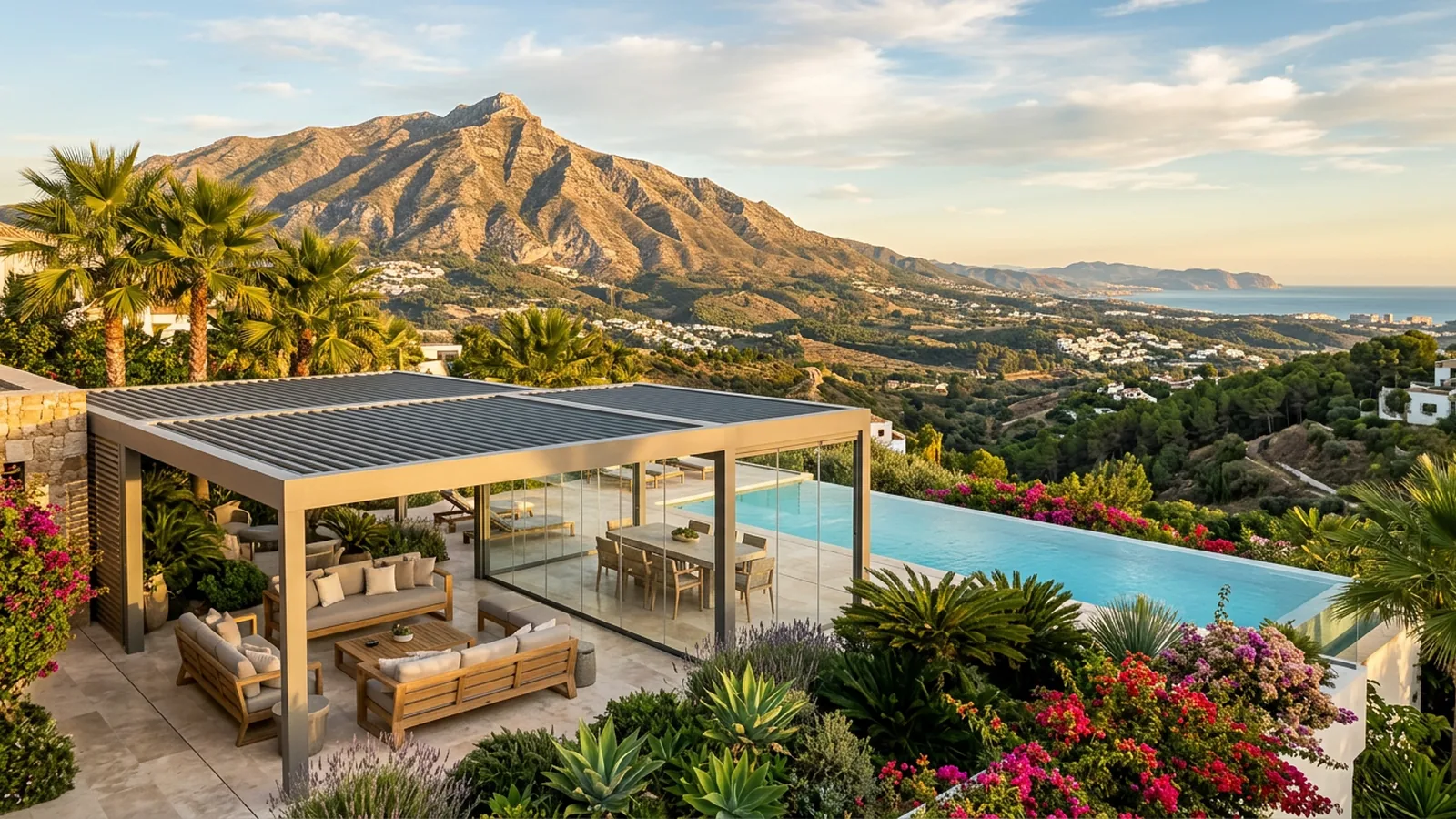
Glass Curtains & Terrace Enclosures in Marbella
Premium glass curtains & glass rooms for your Marbella home — designed and installed by trusted local pros. Free, no-obligation quotes.
Get Your Free QuoteThe Marbella Microclimate: Why Glass Curtains Are Essential on the Costa del Sol Occidental
Marbella, the jewel of the Costa del Sol Occidental, boasts a highly specific geography that directly dictates how we design and install outdoor living spaces. Backed by the dramatic La Concha peak and the Sierra Blanca massif—the imposing foothills of the Sierra de las Nieves national park—the municipality drops steeply down to approximately 27 kilometers of Mediterranean coastline. This unique topography creates a protective microclimate, shielding the town from the worst of the cold northern winds in winter, while keeping summer high temperatures hovering around a comfortable 30 degrees Celsius.
With approximately 2900 sun hours per year and only around 600 mm of annual rainfall, Marbella is prime territory for year-round outdoor living. However, this idyllic climate presents distinct environmental challenges for properties along the coastal strip and up into the hillsides.
The wind patterns in Marbella are dominated by the Poniente (westerly) and Levante (easterly) sea breezes. While the hot, dry terral—a scorching land wind blowing off the inland mountain ranges—hits Marbella less directly than it does Málaga capital, it still occasionally spills over the Sierra Blanca massif, causing sudden daytime temperature spikes.
Furthermore, the solar radiation here is intense. The UV index peaks at very high levels during the summer, regularly reaching indices of 9 to 11 at midday from June through August. This relentless, year-round sun exposure causes rapid UV degradation of outdoor fabrics, traditional awnings, timber decking, and artificial grass, making durable, solid glass enclosures a far more sustainable long-term investment.
At the same time, Marbella’s 27-kilometer shoreline means that salitre (salt spray) exposure is exceptionally high. Salt-laden air acts as an aggressive corrosive agent, attacking metal fittings, structural supports, and moving parts. For properties located anywhere from frontline beach apartments in Puerto Banús to elevated villas in the foothills of Sierra Blanca, installing standard, non-marine-grade glazing systems is a recipe for premature mechanical failure.
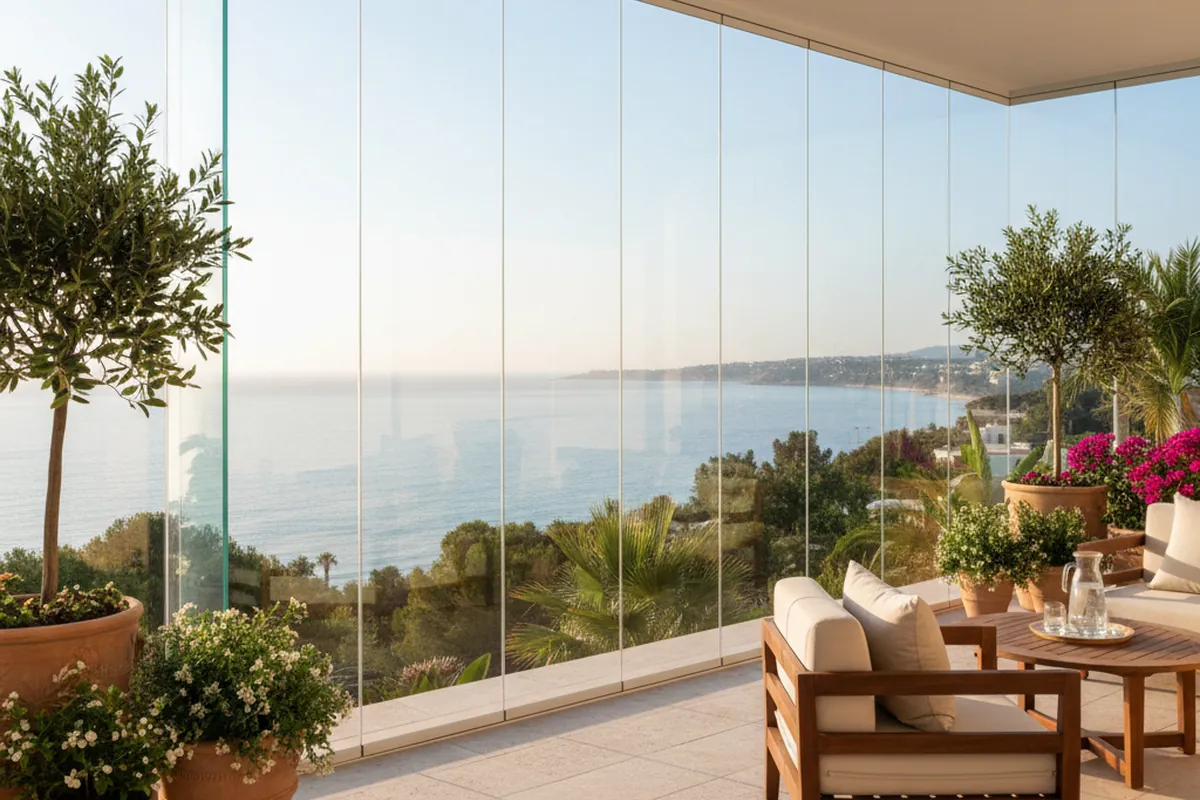
Frameless glass curtains (known locally as cortinas de cristal) provide the ultimate architectural solution. They allow homeowners to seal off their terraces during high-wind Levante or Poniente events, protect expensive outdoor furniture from UV degradation and salt crusting, and trap warmth during cooler winter evenings, all without sacrificing the panoramic Mediterranean views that define Marbella real estate.
Engineering for the Coast: Premium Specifications and Salitre Resistance
Marbella is not a high-volume, low-cost market; it is a premium, villa-led luxury residential arena. High-net-worth international buyers expect materials, finishes, and structural engineering that can withstand the local elements while maintaining a sleek, minimalist aesthetic. When specifying glass curtains for this region, several technical standards are non-negotiable.
Marine-Grade Aluminium and Corrosion Prevention
Because of the high salitre exposure, all aluminium profiles used in Marbella installations must undergo specialized surface treatments. Standard powder coating is insufficient. Installers must utilize profiles treated with Qualicoat Seaside-grade powder coating. This process involves a rigorous acid-etching pre-treatment that removes surface impurities from the aluminium before the polyester powder is electrostatically applied and baked. This prevents filiform corrosion—the spiderweb-like structural bubbling that occurs when salt air penetrates beneath standard paint finishes.
Wind Load and Structural Integrity
Elevated properties in areas like Sierra Blanca, Nagüeles, and the upper ridges of Elviria experience severe wind loads during seasonal storms. Glass curtain systems must be engineered to resist these forces. High-end frameless systems should be certified to meet Clase 6 under the UNE-EN 13659 standard, which guarantees structural resistance and safety under wind pressures equivalent to speeds of up to 175 km/h.
To achieve this, we utilize heavy-duty, thick-walled aluminium tracks and toughened safety glass (tempered glass) with thicknesses of 10 mm or 12 mm, depending on the height of the installation and the local wind exposure. Tempered glass is up to five times stronger than standard annealed glass and, in the highly unlikely event of breakage, fractures into small, blunt-edged granules rather than dangerous shards.
UV-Stable Components and Smooth Operation
The intense summer heat and UV index of 9 to 11 can quickly degrade inferior plastics and sealants. High-spec glass curtains utilize UV-stabilized polymer components, including translucent inter-pane seals that will not yellow, warp, or become brittle under the Mediterranean sun.
Additionally, the sliding and stacking mechanisms must feature marine-grade stainless steel bearings (typically grade AISI 316) housed in self-lubricating polymer rollers. This ensures that even when exposed to fine beach sand and salt spray, the glass panels slide effortlessly along the tracks, allowing for single-handed operation.
Navigating Marbella's Complex Planning Regulations and Community Approvals
Installing glass curtains in Marbella requires careful navigation of both local municipal planning laws and national property legislation. The town's planning history is complex, and failing to secure the correct permissions can result in significant fines or orders to restore the property to its original state.
The Municipal Planning Landscape (PGOU and PGOM)
The planning status of many properties in Marbella remains legally delicate. The municipal planning document of 2010 (PGOU) was annulled by the Spanish Supreme Court in a series of rulings, the first of which was handed down on October 27, 2015. This landmark decision restored the older 1986 PGOU as the active, governing urban plan for the municipality.
While a modern, updated PGOM (Plan General de Ordenación Municipal) received a favorable report from the Junta de Andalucía in February 2026 and currently awaits final plenary approval, the planning status of approximately 18,000 properties across the municipality remains legally uncertain. Consequently, before quoting or initiating any structural or semi-permanent outdoor works, it is essential to verify the specific planning classification of the plot against both the 1986 PGOU and any active protected-zone overlays, such as those governing parts of Sierra Blanca or Las Chapas.
Municipal Permits: Obra Mayor vs. Declaración Responsable
A common misconception among homeowners is that glass curtains can be installed under a simple declaración responsable (a fast-track prior notification process used for minor home improvements).
In the municipality of Marbella, local ordinances explicitly exclude terrace glazing, enclosures (acristalamiento), and any works that could be construed as expanding the built volume of a property from the declaración responsable pathway. Because glass curtains enclose a previously open space, the Ayuntamiento de Marbella classifies these installations as requiring a full municipal building licence (obra mayor), rather than a simple obra menor.
For detached villas, this means submitting an architectural project signed by a registered architect. For pergolas, while small structures of less than approximately 5 square meters often require no formal municipal licence, the Ayuntamiento de Marbella has issued a specific interpretive criterion regarding the setback and separation distance from property boundaries that must be strictly respected.
Coastal Zone Restrictions (Ley de Costas)
For frontline beach properties along Marbella's 27-kilometer coast, the Spanish Coastal Law (Ley de Costas) imposes strict regulations. Any construction or modification within the servidumbre de protección (protection easement zone), which typically extends between 20 and 100 meters inland from the maritime-terrestrial public domain, requires authorization from the regional delegation of the Junta de Andalucía before the local town hall can issue a building permit. Installing glass curtains on a frontline beach terrace in Puerto Banús or Las Chapas must be carefully vetted to ensure compliance with these state-level environmental protections.
The Ley de Propiedad Horizontal (LPH) for Communal Buildings
If your property is an apartment or townhouse located within a community of owners (comunidad de propietarios), you must also comply with Spain’s Ley de Propiedad Horizontal.
Under the LPH, any modification that alters the external aesthetic, façade, structural elements, railings, or visible awnings of a building requires formal approval from the community. Installing glass curtains—even frameless ones designed to minimize visual impact—falls under this rule.
To proceed legally, the homeowner must secure a qualified majority of three-fifths (3/5) of the owners, who must also represent three-fifths of the community's total participation quotas, during an official community AGM or EGM. Many established urbanizaciones in Marbella have pre-approved specific, uniform glass curtain systems and frame colors to maintain architectural harmony across the complex, making the approval process much simpler for new buyers.
Tailoring Glass Curtains to Marbella’s Exclusive Neighborhoods
Marbella's real estate market is highly segmented, ranging from sprawling hillside estates to frontline beach penthouses. Each neighborhood presents unique environmental and architectural conditions that dictate the design of a glass curtain installation.
+-----------------------------------------------------------------------------+
|                               MARBELLA REGION                               |
+-----------------------------------------------------------------------------+
                                       |
       +-------------------------------+-------------------------------+
       |                                                               |
       v                                                               v
+------------------------------+                               +------------------------------+
|       HILLSIDE ZONES         |                               |        COASTAL ZONES         |
| (Sierra Blanca, Nagüeles,    |                               | (Golden Mile, Puerto Banús,  |
|      Valle del Golf)         |                               |     Elviria, Las Chapas)     |
+------------------------------+                               +------------------------------+
       |                                                               |
       v                                                               v
* High altitude wind loads     |                               * Extreme salitre exposure
* Thermal insulation focus     |                               * Wind resistance (Clase 6)
* Integrated bioclimatic       |                               * Frontline beach setbacks
  pergolas for large estates   |                                 (Ley de Costas compliance)
Sierra Blanca and Nagüeles
Perched in the foothills of the Sierra Blanca massif, these ultra-exclusive, villa-led residential zones experience higher wind velocities and slightly cooler winter temperatures than the coastal strip. Properties here feature expansive terraces with sweeping views of the Mediterranean.
In Sierra Blanca, installations typically involve large-scale, floor-to-ceiling frameless glass curtains. Because these villas often feature high ceilings, we recommend 12 mm tempered glass panels to handle the elevated wind pressures. These systems are frequently integrated with large-scale bioclimatic pergolas, creating massive, protected outdoor lounges that can be fully opened during calm summer days or sealed against the mountain breezes in winter.
Nueva Andalucía (Valle del Golf, Los Naranjos, and Aloha)
The Valle del Golf is characterized by luxury villas and high-end apartment complexes nestled around world-class golf courses like Los Naranjos and Aloha. The primary design goal here is to blend indoor spaces seamlessly with manicured lawns and golf course views.
For apartments and townhouses in this area, glass curtains are commonly used to enclose naya terraces. This protects outdoor dining areas and high-end outdoor kitchens from the heavy morning dew and occasional winter rains, allowing golf enthusiasts to utilize their terraces year-round.
Puerto Banús and the Golden Mile
The Golden Mile corridor, linking Marbella centre to Puerto Banús, is bordered by the Río Verde on its western flank and represents the pinnacle of frontline beach luxury. Properties here face extreme salitre exposure and strong sea breezes.
For frontline apartments in Puerto Banús, we install bottom-weighted frameless systems that minimize the load on upper terrace ceilings while providing maximum resistance to salt-air corrosion. Every single metallic component must be marine-grade stainless steel, and the glass panels are treated with hydrophobic coatings to prevent salt crusting and water spotting, keeping the views of the luxury yachts and the Mediterranean crystal clear.
Elviria and Las Chapas
Located on the eastern side of Marbella, these areas feature a mix of pine-forested villa estates and beachside apartments near the protected dunes of Artola. Properties close to the beach must strictly respect the Ley de Costas setbacks.
In the elevated parts of Elviria, where properties enjoy panoramic views stretching to the North African coast, wind resistance is the primary engineering concern. Here, we specify heavy-duty systems certified to Clase 6 wind resistance, ensuring safety during winter storms.
San Pedro de Alcántara
Delineated on its western flank by the Río Guadalmina, San Pedro features a bustling town center, a modern beachside boulevard, and established residential zones. The properties here range from contemporary apartments to traditional townhouses.
Installations on San Pedro's beachside apartments often focus on maximizing the usable square footage of compact balconies, utilizing space-saving stacking systems that fold neatly against the interior walls to keep the terrace fully open when desired.
Cost Estimates and Turnkey Integration with Luxury Outdoor Living
Investing in high-spec outdoor living solutions in Marbella requires an understanding of the local pricing structures and how different systems integrate to create a cohesive, high-end environment.
Price Guidelines for Premium Installations
Because Marbella is a premium market demanding top-tier materials, prices reflect the necessity for marine-grade finishes, thick tempered glass, and professional, warranted installations.
- Frameless Glass Curtains: Expect to invest between 300 and 500 EUR per square meter, fully installed. The final price depends on the glass thickness (10 mm or 12 mm), the choice of custom RAL or anodized marine-grade finishes for the profiles, the height of the panels, and whether the installation requires complex track configurations, such as navigating corners or curved terraces.
- Bioclimatic Pergolas: To create a truly versatile outdoor room, glass curtains are frequently paired with motorized bioclimatic pergolas. These structures cost between 300 and 800 EUR per square meter. They feature adjustable motorized louvers, integrated drainage, LED lighting, and automated wind and rain sensors that automatically close the louvers during sudden downpours or open them during high-wind events to prevent uplift.
- Outdoor Kitchens: A major trend among international buyers in Nueva Andalucía and Sierra Blanca is the installation of fully equipped outdoor kitchens. Ranging from 4000 to 15000 EUR, these premium culinary spaces feature marine-grade stainless steel, built-in barbecues, stone countertops, and outdoor refrigeration. Enclosing these kitchens with glass curtains ensures they remain protected from the corrosive salt air and winter dampness, significantly extending their lifespan.
Turnkey Property Management and Maintenance for Expat Owners
Marbella has a highly cosmopolitan population. According to the 2024 municipal padrón (INE), the town has a population of 166,999, with approximately 33 percent of these residents being foreign-born (52,173 registered residents born abroad, representing 153 different nationalities). The top foreign nationalities include the United Kingdom, Morocco, Ukraine, Colombia, Russia, Scandinavian countries (Sweden, Norway, and Denmark), Germany, and the Belgium/Netherlands region.
A significant portion of these international residents utilize their Marbella properties as second homes, leaving them vacant for several months of the year. For these owners, turnkey property management and preventative maintenance are essential services.
When installing glass curtains, we highly recommend opting for comprehensive maintenance contracts. Because of the high salitre and dust levels carried by the Poniente and Levante winds, tracks must be kept clean and free of debris.
An annual maintenance service typically includes:
- Clearing and vacuuming the lower tracks and drainage channels to prevent water ingress.
- Lubricating the stainless steel bearings and nylon rollers with specialized dry silicone sprays (wet lubricants should be avoided as they attract sand and grit).
- Checking and adjusting the alignment of the panels to ensure the locking mechanisms engage smoothly.
- Inspecting the inter-panel polymer seals and replacing any that show signs of wear or UV degradation.
By securing a professional installation that complies with Marbella's strict municipal planning codes, respects the Ley de Propiedad Horizontal, and utilizes materials engineered specifically for high-salitre and high-UV environments, homeowners can enjoy a seamless transition between indoor and outdoor living, adding substantial long-term value to their Costa del Sol properties.
Why Buy From Us
Trusted Local Professionals
We connect you with vetted installers and specialists across the Costa del Sol — Estepona to Nerja.
Free, No-Obligation Quotes
Compare options and get a clear local price. No pressure, no guesswork.
Service in Your Language
Quotes and support in English, German, Dutch and French — every step.
We Live Here Too
We're expats ourselves. We understand your home because we know this coast — climate, salitre, permits.
Get Your Free Outdoor Living Quote
Tell us what you need. We respond within 2 hours with pricing and availability.
or message us directly
WhatsApp Us NowFrequently Asked Questions
How do I get a quote for glass curtains & glass rooms in Marbella?
How much do glass curtains & glass rooms cost in Marbella?
Do you cover Marbella?
Do I need a licence for glass curtains & glass rooms in Marbella?
 JW'"
/>
JW'"
/>
Founder & Outdoor Living Specialist
Founder of Costa del Sol Outdoors. Outdoor & interior designer based in Estepona, helping expats create beautiful Mediterranean outdoor spaces with trusted local installers.