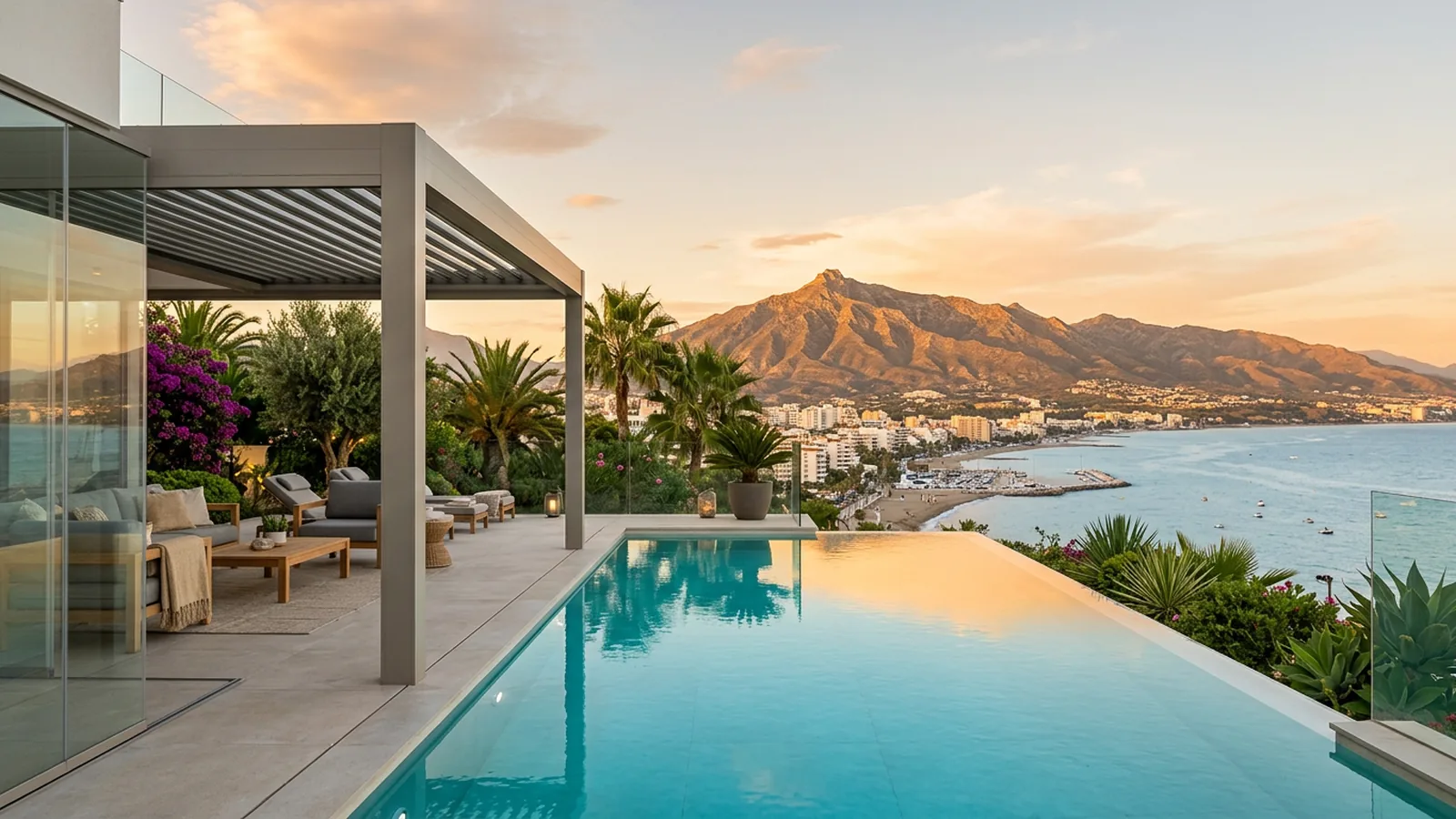
Glass Curtains & Terrace Enclosures in Fuengirola
Premium glass curtains & glass rooms for your Fuengirola home — designed and installed by trusted local pros. Free, no-obligation quotes.
Get Your Free QuoteMaximising Year-Round Terrace Living in Fuengirola with Frameless Glass Curtains
Fuengirola is one of the most vibrant, compact, and cosmopolitan hubs on the Costa del Sol Occidental. Bounded to the north by the dramatic slopes of the Sierra de Mijas and to the southwest by the Río Fuengirola—where the historic 10th-century Castillo Sohail has stood since its construction in 956 under Abderramán III—this coastal city packs incredible energy into a narrow strip of land.
With a surface area of just 10.36 square kilometres, Fuengirola is almost fully urbanised, making it one of the most densely populated municipalities in Spain. According to the INE, the town's population stands at 85,211 (2025 data), having grown from 85,859 on the 1 January 2024 municipal padrón. It ranks as the fifth most populated municipality in Málaga province. Because land is at an absolute premium, the local property market is heavily vertical. Unlike the sprawling villa estates of neighbouring Marbella, Fuengirola is a high-density, apartment-dominated market.
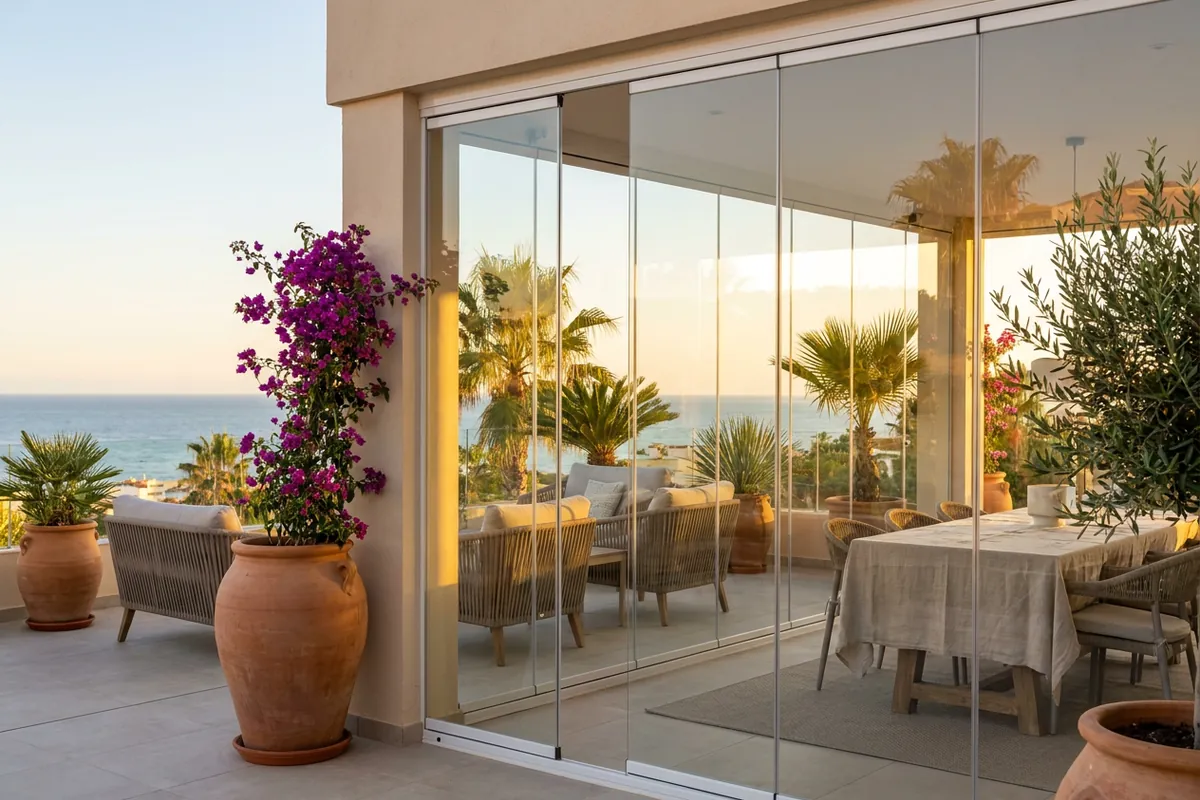
For the thousands of homeowners living along Fuengirola's eight kilometres of Mediterranean shoreline, the terrace is the most valuable square footage in the property. However, urban apartment living presents distinct environmental and spatial challenges. Frameless glass curtains (cortinas de cristal) have transitioned from a luxury upgrade to an essential home installation. They allow residents to reclaim their balconies from the elements, transforming exposed outdoor spaces into versatile, year-round living areas without sacrificing the panoramic sea views that make this coast so desirable.
The Fuengirola Microclimate: Why Salitre, Terral, and Levante Winds Demand Premium Glass Quality
Fuengirola enjoys an enviable Mediterranean climate with approximately 2,880 sun hours per year, mild winters, and summer highs averaging around 30 degrees Celsius. However, its unique geography—a narrow coastal plain backed by mountains—creates a highly specific microclimate that puts outdoor building materials to the ultimate test.
High Salitre (Salt Air) Exposure
With the Paseo Marítimo running almost the full length of the seafront, properties in districts like Los Boliches, Carvajal, and the Centro/Miramar area are subject to constant marine corrosion. The air is thick with salitre (salt spray), which quickly degrades low-grade metals and hardware. When installing glass curtains in Fuengirola, standard aluminum and basic steel components are highly vulnerable. Installers must use marine-grade anodised aluminium profiles (ideally with a Qualicoat Seaside certification) and marine-grade stainless steel (316 stainless steel) for all rollers, hinges, and locking mechanisms to prevent pitting, rusting, and system failure.
Intense UV Radiation
With nearly 3,000 hours of sunshine annually and a summer UV index that consistently reaches 9 to 10+ from June to August, materials degrade rapidly. Standard PVC seals used between glass panes in cheaper systems will yellow, warp, and crack within a couple of seasons. High-quality installations require UV-stabilised translucent h-seals or premium magnetic seals that maintain their flexibility and clarity under intense insolation.
The Dynamics of Levante, Poniente, and Terral Winds
Fuengirola's coastline is highly exposed to the Levante (easterly) and Poniente (westerly) sea breezes. Furthermore, during the summer months, the town occasionally experiences the Terral—a hot, dry wind that sweeps down from the Sierra de Mijas, causing temperatures to spike rapidly.
Because many apartments in Fuengirola are located in high-rise blocks along the beachfront, wind loads can be severe. A glass curtain system installed on a tenth-floor penthouse in Torreblanca del Sol must be engineered to withstand heavy pressure. Homeowners should look for systems certified to Clase 6 under the UNE-EN 13659 standard, which guarantees wind resistance up to 175 km/h. Tempered safety glass of 8mm, 10mm, or even 12mm thickness is used depending on the height of the installation and the wind load calculations for that specific building.
Tailoring Glass Curtains to Fuengirola's Diverse Neighborhoods
Fuengirola is a tapestry of distinct residential quarters, each with its own architectural style, building heights, and demographic profile. Understanding these local nuances is key to selecting the right glass enclosure system.
Los Boliches and Carvajal
These are high-density, traditional beachfront areas dominated by multi-storey apartment blocks facing directly onto the Mediterranean. Properties here experience maximum exposure to salt spray and high winds. Glass curtains in Los Boliches and Carvajal are primarily installed on mid-to-high-level balconies to block the wind and sea spray, allowing owners to keep their outdoor furniture on the terrace year-round without it being ruined by the damp, salty air.
El Higuerón (Reserva del Higuerón)
Located on the steep slopes bordering Benalmádena, El Higuerón is Fuengirola's premium, mass-affluent to luxury enclave. Here, modern penthouses and high-end villas demand sleek, minimalist designs. Homeowners in El Higuerón typically opt for top-tier, bottom-weighted, flush-mounted glass curtains that slide and stack seamlessly, preserving the uninterrupted, elevated views of the coastline. These installations are frequently paired with high-end bioclimatic pergolas (ranging from 300 to 800 EUR per square metre) and custom outdoor kitchens (costing between 4,000 and 15,000 EUR) to create ultimate luxury penthouses.
Torreblanca del Sol and Los Pacos
Torreblanca features a mix of hillside apartments and villas, where wind resistance is a primary concern due to the elevation. Los Pacos, located slightly inland, is a highly popular residential area with a massive Finnish community. In fact, Fuengirola is widely known as the de-facto Finnish capital of Spain, hosting around 4,657 Finnish residents (5.6% of the population). Scandinavian buyers are highly accustomed to glass-enclosed balconies from their home countries, where they are used for thermal insulation. In Los Pacos, glass curtains are highly sought after to trap solar heat during the cooler winter months, reducing heating costs and creating a cozy, sunlit Scandinavian-style sunroom.
Pueblo López and Centro / Miramar
Pueblo López is a unique, low-rise oasis of Andalusian-style townhouses with picturesque patios. Here, glass curtains are used differently—often to enclose traditional arched porticos or patios, protecting them from winter rains while preserving the rustic aesthetic. In contrast, the bustling Centro and Miramar areas consist of dense apartment blocks where balconies are often small. In these tight urban spaces, space-saving slide-and-stack glass systems are preferred over traditional inward-swinging doors, as they do not consume valuable floor space when fully opened.
Navigating Local Regulations: Ayuntamiento de Fuengirola, Comunidad Approvals, and the Ley de Costas
Installing a glass curtain in Fuengirola is not just a matter of choosing a contractor; it requires careful navigation of local municipal laws, community rules, and, in some cases, national coastal protections.
Ayuntamiento de Fuengirola and the PGOU
Any exterior modification in the municipality is governed by the Plan General de Ordenación Urbana (PGOU) managed by the Ayuntamiento de Fuengirola (Urbanismo department, contactable at tel. 952 58 93 05).
Under local guidelines, minor works (obras menores) are categorized into specific tiers:
- Declaración Responsable Obras Tipo A: This covers low-complexity interior reparations (such as tiling, painting, or replacing sanitary fixtures) that do not alter the building's exterior or structural elements.
- Declaración Responsable Obras Tipo B: This is required for works that alter the exterior appearance of the building but do not affect structural integrity. Installing glass curtains or changing terrace enclosures often falls under this tier, requiring the submission of basic graphic documentation and, crucially, a formal agreement from the Comunidad de Propietarios (homeowners' association).
- Licencia de Obra Menor Tipo 3: If the installation is part of a larger renovation project requiring technical drawings drafted by an architect and visaed (visado) by the corresponding professional college, this license is required.
- Obra Mayor: Any work that alters the volume of the property, encloses a terrace with permanent brick walls, or impacts structural elements will trigger an obra mayor requirement, which involves a full architectural project and significantly higher fees. Because frameless glass curtains are classified as non-permanent, fully demountable, and non-volume-increasing installations, they generally avoid the complex obra mayor pathway, making them the preferred legal choice for enclosing balconies.
The Ley de Costas (Coastal Law)
For frontline properties situated along the Paseo Marítimo in Carvajal, Los Boliches, and central Fuengirola, the Spanish Ley de Costas applies. Any property located within the servidumbre de protección (protection easement zone)—which is typically 100 metres from the public maritime-terrestrial domain, but reduced to 20 metres in consolidated urban areas—must comply with strict regulations.
Before the Ayuntamiento de Fuengirola can issue any building permit or accept a Declaración Responsable for properties within this zone, a prior express authorization must be obtained from the Junta de Andalucía (the regional autonomic coastal authority). Because frameless glass curtains do not add permanent structural volume to the building, they are far more likely to be approved under these strict coastal guidelines than traditional framed aluminum enclosures.
Comunidad de Propietarios (HOA) Approval
Because Fuengirola is characterized by high-density, vertical apartment blocks, the Ley de Propiedad Horizontal (Horizontal Property Law) dictates that any modification affecting the facade of a building requires the approval of the Comunidad de Propietarios.
Traditional framed glass enclosures, which use thick aluminum profiles, alter the uniform aesthetic of the building's facade and are frequently rejected by communities. Frameless glass curtains, however, are highly favoured by communities because they are virtually invisible from the street when closed, preserving the architectural integrity of the building. Nevertheless, you must obtain written permission from your community administrator before proceeding with the installation.
Technical Specifications and Cost Guide for Fuengirola Homeowners
When investing in terrace improvements, understanding the technical specifications and realistic pricing helps ensure a high-quality installation that withstands the coastal environment.
| Product / Service | Average Price Range (Installed) | Key Technical Specifications to Demand |
|---|---|---|
| Frameless Glass Curtains | €300 – €500 per m² | 8mm to 10mm tempered safety glass; Qualicoat Seaside marine-grade aluminum; stainless steel components; Clase 6 wind resistance (UNE-EN 13659). |
| Bioclimatic Pergolas | €300 – €800 per m² | Extruded aluminum structure; motorized adjustable louvres; integrated drainage; wind resistance up to 120 km/h. |
| Outdoor Kitchens | €4,000 – €15,000+ | Marine-grade 316 stainless steel or HPL (High-Pressure Laminate) cabinetry; Dekton or granite countertops (UV and scratch-resistant). |
System Types: Sliding vs. Slide-and-Stack
There are two primary configurations for glass curtains:
- Slide-and-Stack (Pivot) Systems: The glass panels slide along a single track and fold inward at the end, stacking neatly against the wall like the pages of a book. This allows for a 100% opening of the terrace, which is perfect for enjoying the cool Levante breeze on warm summer evenings.
- Sliding Systems: The panels slide parallel to one another on a multi-track rail. While they do not swing inward (making them ideal for tight balconies with furniture close to the glass), they do not allow a 100% opening, as the panels stack behind one another, leaving at least one panel's width closed.
Integrating Glass Curtains into the Cosmopolitan Fuengirola Lifestyle
Fuengirola is home to one of the highest percentages of foreign residents on the Costa del Sol. Between 37% and 43% of the population is foreign-born, representing over 140 nationalities. The British community is the largest foreign group (approximately 5,508 residents, or 6.7%), closely followed by the Finns (4,657 residents, or 5.6%), Moroccans (2,763, or 3.4%), and growing numbers of Swedish, Italian, and Ukrainian (around 903) residents.
This diverse, mass-affluent buyer profile prioritises outdoor living, but they also demand low-maintenance, "lock-and-leave" security. Many properties are second homes or lucrative holiday rentals. Glass curtains provide an exceptional security barrier when the property is unoccupied, protecting the interior from driving rain, dust, and pests, while allowing natural light to flood the apartment.
Solar Protection and Temperature Control
While glass curtains are excellent for keeping wind and rain out, enclosing a south-facing balcony in Fuengirola during July can create a greenhouse effect. To maintain a comfortable temperature, glass curtains should be integrated with:
- Toldos (Awnings): High-quality, wind-resistant awnings installed on the exterior of the glass curtain block solar radiation before it hits the glass.
- Solar Control Glass: Opting for treated glass (such as Guardian Sun) that reflects a high percentage of solar heat while letting light through.
- Ventilation Locks: High-quality glass curtain systems feature a "micro-ventilation" locking position, allowing a safe, steady airflow to prevent condensation and heat buildup without needing to open the panels fully.
By combining premium frameless glass curtains with robust local planning knowledge and high-quality materials, Fuengirola homeowners can successfully extend their living space, protect their property investment, and enjoy the stunning Mediterranean views of the Costa del Sol Occidental in comfort, every day of the year.
Why Buy From Us
Trusted Local Professionals
We connect you with vetted installers and specialists across the Costa del Sol — Estepona to Nerja.
Free, No-Obligation Quotes
Compare options and get a clear local price. No pressure, no guesswork.
Service in Your Language
Quotes and support in English, German, Dutch and French — every step.
We Live Here Too
We're expats ourselves. We understand your home because we know this coast — climate, salitre, permits.
Get Your Free Outdoor Living Quote
Tell us what you need. We respond within 2 hours with pricing and availability.
or message us directly
WhatsApp Us NowFrequently Asked Questions
How do I get a quote for glass curtains & glass rooms in Fuengirola?
How much do glass curtains & glass rooms cost in Fuengirola?
Do you cover Fuengirola?
Do I need a licence for glass curtains & glass rooms in Fuengirola?
 JW'"
/>
JW'"
/>
Founder & Outdoor Living Specialist
Founder of Costa del Sol Outdoors. Outdoor & interior designer based in Estepona, helping expats create beautiful Mediterranean outdoor spaces with trusted local installers.