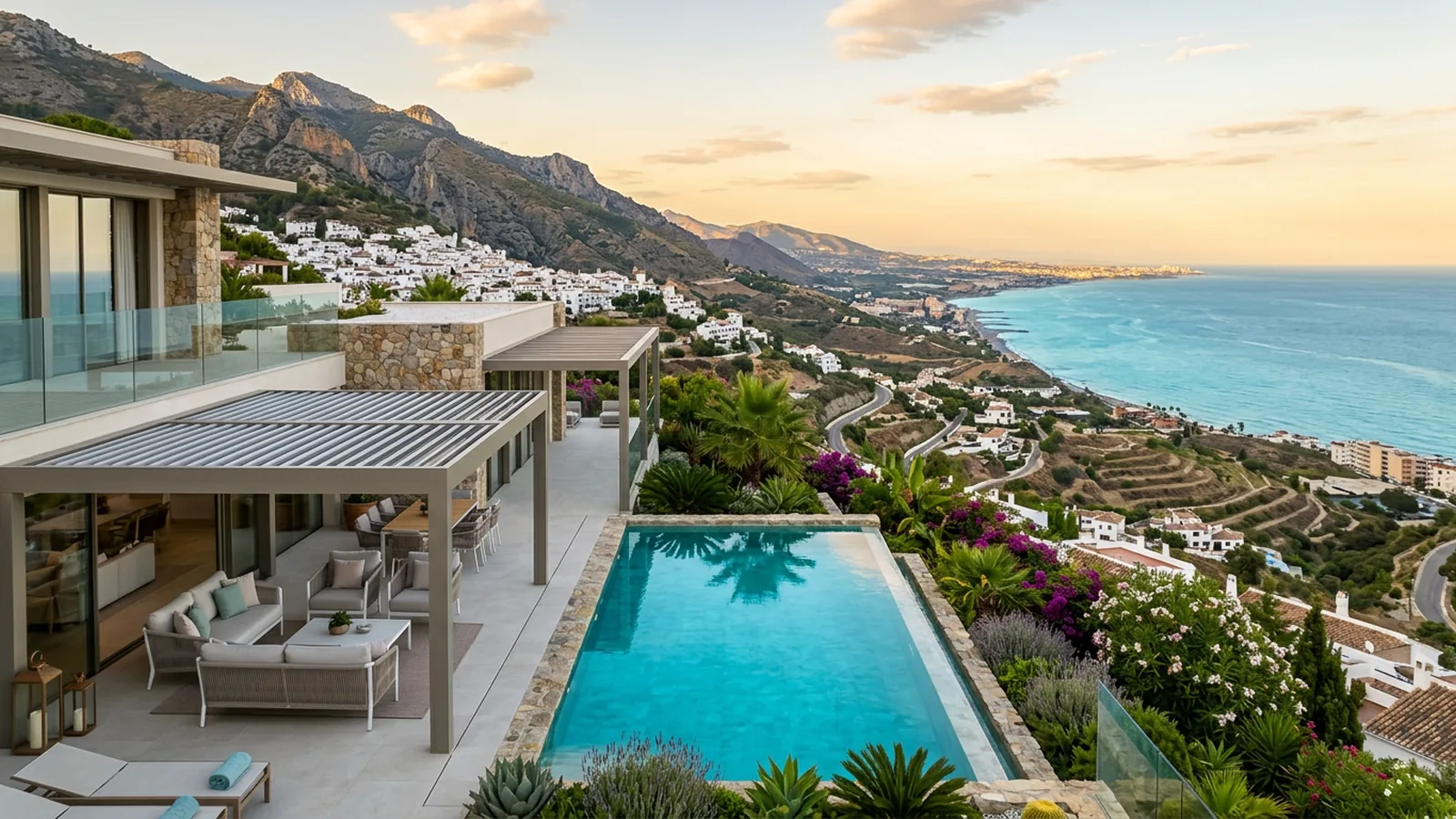
Shade Sails in Mijas
Premium shade sails for your Mijas home — designed and installed by trusted local pros. Free, no-obligation quotes.
Get Your Free QuotePremium Velas de Sombra in Mijas: Professional Shade Sail Design and Installation
For homeowners across the vast and geographically diverse municipality of Mijas, shade is not a luxury—it is an absolute architectural necessity. Stretching from the sun-drenched shores of Mijas Costa up to the elevated, pine-fringed slopes of Mijas Pueblo at 430 metres above sea level, this sector of the Costa del Sol Occidental experiences some of the most intense solar radiation in Andalusia.
With over 320 sunny days a year and approximately 3,000 hours of annual sunshine, properties here face a relentless solar load. During the peak of summer, temperatures regularly climb into the high 30s°C, and the UV index frequently spikes to 9, 10, or even higher. This extreme UV exposure causes rapid material degradation, fading fabrics, cracking timber, and scorching artificial grass.
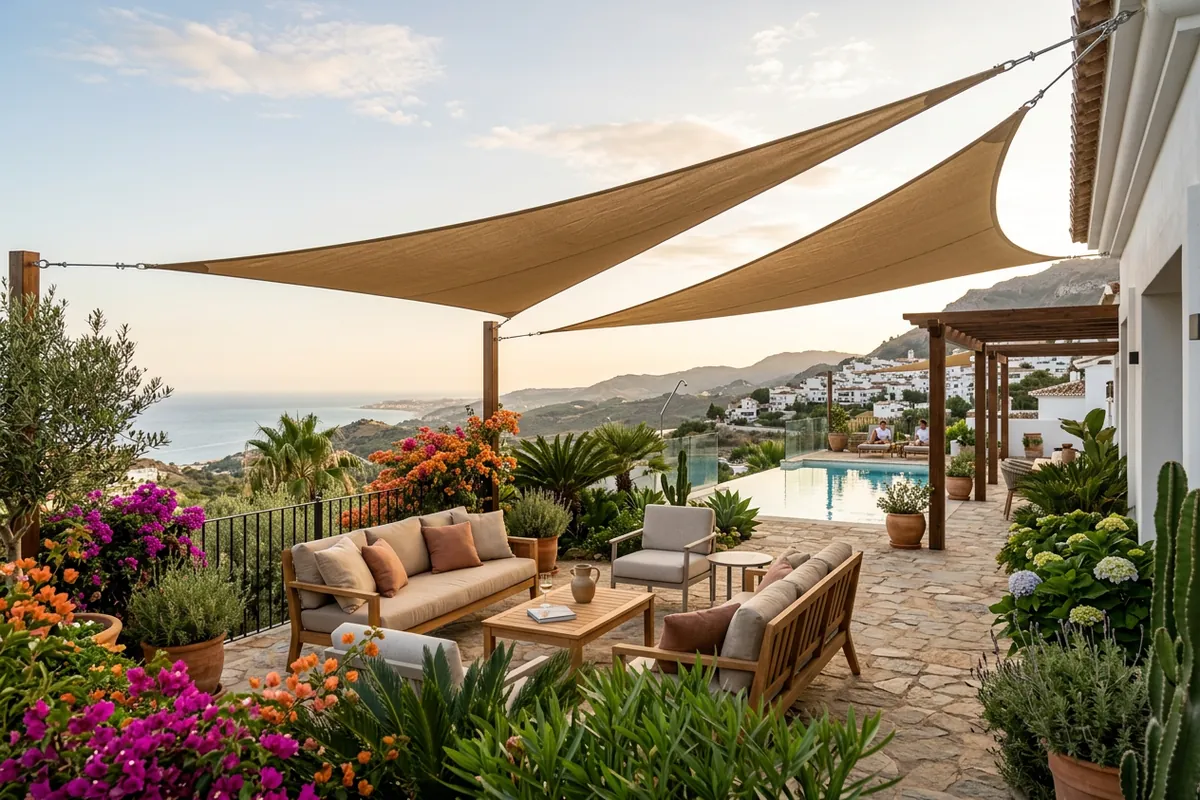
To reclaim outdoor living spaces, premium velas de sombra (tensioned shade sails) have become the gold standard for sun protection. Engineered to withstand the unique microclimates of the Sierra de Mijas and the coastal strip, a professionally designed and installed shade sail offers a striking, architectural alternative to traditional awnings or heavy wooden pergolas.
The Mijas Microclimate: Wind, Salt, and the Terral
Designing and installing high-performance shade sails in Mijas requires a deep understanding of local geography and meteorology. The municipality’s 148.8 square kilometres straddle a dramatic limestone range—the Sierra de Mijas, which peaks at around 1,150 metres—and extend down to a 12-kilometre stretch of Mediterranean coastline. This topography creates distinct microclimatic challenges that vary significantly by zone.
The Double Threat: Levante and Poniente Winds
Mijas is constantly subjected to coastal sea and land breezes, alongside two dominant regional winds: the Levante (a humid, easterly wind blowing off the Mediterranean) and the Poniente (a warmer, drier westerly wind). In coastal urbanizaciones like Calahonda (Sitio de Calahonda), Riviera del Sol, Torrenueva, El Faro, and El Chaparral, these winds can accelerate rapidly across open terraces and beachfront plots.
Furthermore, during the summer, Mijas occasionally experiences the terral—a scorching, dry wind that blows down off the Sierra de Mijas. As this air descends from the mountains, it compresses and heats up rapidly, bringing sudden gusts of hot air and extreme thermal stress to outdoor structures.
To prevent catastrophic failure during high-wind events, professional shade sail installations in Mijas must be engineered to withstand severe aerodynamic loads. High-end sails are designed and tensioned to meet stringent wind resistance standards, often engineered to comply with Clase 6 under the UNE-EN 13659 standard (withstanding wind forces up to 175 km/h). This involves:
- Using marine-grade 316 stainless steel tensioning hardware (turnbuckles, shackles, and pad eyes).
- Installing heavy-duty structural steel or extruded aluminium posts anchored deep into reinforced concrete footings.
- Incorporating dual-ring corner reinforcements with heavy-weight seatbelt webbing stitched along the sail's perimeter.
Salitre (Salt Air) and Corrosion Resistance
Along the coastal strip of La Cala de Mijas, Miraflores, and seafront apartment blocks in Las Lagunas, salitre (salt spray) is highly corrosive. Standard powder-coated steel or low-grade metals will rust, pit, and fail within a few seasons.
For coastal installations, marine-grade materials are mandatory. All structural posts must be either marine-grade anodized aluminium or hot-dip galvanized steel finished with a marine-grade Qualicoat polyester powder coating. Every screw, bolt, and tensioning cable must be premium 316 stainless steel to resist the relentless salt-laden air.
Demographics and Property Profiles: Tailoring Shade to the Mijas Market
Mijas is one of the fastest-growing municipalities on the Costa del Sol. Its population has surged from around 85,000 in the middle of the last decade, surpassing 91,000 in 2021, to reach 95,104 inhabitants as of January 2025 (according to the municipal padrón and INE-cited figures).
It is also one of the most international communities in Andalusia. Foreign-born residents account for approximately 37% of the padrón, and foreign-nationality residents are commonly cited as making up between 40% and 49.7% of the total population.
Among the 127 nationalities represented, the British community is the largest, with around 10,000 residents—the largest British municipal community in all of Andalusia. The Nordic and Scandinavian communities are also highly prominent, with approximately 2,886 combined residents (led by Swedes at around 900, alongside Danish, Finnish, and Norwegian nationals). German (~1,020 residents), Moroccan, Belgian, and Dutch communities complete the primary demographic groups.
This highly international, bilingual (English and Spanish) expat profile has distinct property ownership patterns, which directly influence the types of shade systems installed:
1. Premium Villas and Golf-Side Homes
In exclusive inland and golf-front estates such as La Cala Golf, Mijas Golf, the upper hillsides of Calahonda, El Chaparral, and El Coto, properties typically consist of expansive, high-value detached villas.
- The Shade Solution: Homeowners in these areas demand architectural integration. Large-scale, multi-sail hypar (hyperbolic paraboloid) designs are highly popular here. These installations feature overlapping, three-dimensional sails in contrasting neutral tones (such as charcoal, sand, and stone) that mirror the contemporary lines of modern villas.
- Complementary Upgrades: These premium properties often combine shade sails with high-end bioclimatic pergolas (costing between 300 and 800 EUR per square metre), bespoke outdoor kitchens (ranging from 4,000 to 15,000 EUR), and professional landscaping featuring premium UV-stable artificial grass installation (typically 25 to 60 EUR per square metre) to create seamless, year-round outdoor living zones.
2. High-Volume Apartments and Townhouses
In high-density coastal areas like Riviera del Sol, the urban core of Las Lagunas (which is fused with Fuengirola), and central La Cala de Mijas, properties are predominantly apartments, penthouses, and compact townhouses. Many of these are owned by non-residents or holiday-home investors who require low-maintenance, lock-up-and-go solutions.
- The Shade Solution: For these properties, space is at a premium, and structural modifications are restricted. Wall-mounted triangular or rectangular shade sails are ideal. They provide maximum shade coverage over narrow balconies, roof terraces, and small garden patios without taking up valuable floor space with vertical posts.
- Complementary Upgrades: To maximize these smaller spaces, owners frequently pair shade sails with glass curtains (costing 300 to 500 EUR per square metre) to enclose terraces for winter use, alongside high-efficiency air conditioning systems and professional property management services to oversee the home when empty.
Navigating Regulations, Permits, and Communities in Mijas
Installing outdoor structures in Mijas requires careful navigation of local planning laws, environmental protections, and community rules. Failing to secure the correct permissions can lead to heavy fines from the Ayuntamiento de Mijas or forced removal of the installation.
1. Comunidad de Propietores (HOA) Approval
Before approaching the town hall, any homeowner living within an urbanización must consult their Comunidad de Propietores (Community of Owners). Under Spanish horizontal property law, any modification that alters the exterior aesthetic of a building—including awnings, pergolas, glass curtains, and shade sails—must be formally approved by the community administration. Most communities have strict rules regarding permitted fabric colours (often restricting choices to specific shades of beige, white, or blue) and mounting locations to maintain visual harmony across the development.
2. Ayuntamiento de Mijas Planning Permits
The municipal planning framework is governed by the PGOU de Mijas (Texto Refundido 2013, with a major PGOU modification registered and published over 2024–2025).
- Obra Menor (Minor Works): The installation of temporary or semi-permanent shade sails, lightweight pergolas, and terrace decking generally falls under the declaración responsable (responsible declaration) or licencia de obra menor (minor works license) procedure. This is a streamlined process, but it still requires submitting basic technical drawings, a budget, and paying the municipal construction tax (ICIO).
- Obra Mayor (Major Works): If the shade installation involves heavy structural engineering, massive concrete foundations, or permanent steel structures that alter the property's footprint, it may be classified as an obra mayor. This requires a full, visado-stamped project drafted by an architect registered with the college of architects (COA).
3. Coastal and Environmental Constraints
Mijas features two highly sensitive geographical zones that trigger additional regulatory oversight:
- The Ley de Costas (Coastal Law): For frontline beach properties along Mijas Costa (from Calahonda down to El Faro), any plot falling within the servidumbre de protección (protection easement) setback zone is subject to strict coastal regulations. Any outdoor construction or installation within this zone requires explicit, additional authorization from the Demarcación de Costas before the Mijas Ayuntamiento can issue a building permit.
- Protected Mountain Zones: The Sierra de Mijas (specifically the Sierra de Mijas-Alpujata region) encompasses approximately 29,000 hectares of protected monte público (public woodland) and is a candidate for National Park status (backed by the CSIC). Hillside plots in Mijas Pueblo, Valtocado, and upper Calahonda that border these protected pine forests face stringent environmental constraints, particularly regarding fire-prevention setbacks, landscape integration, and the use of non-reflective, natural-toned materials.
Material Science: Choosing the Right Fabric for the Costa del Sol
To survive the punishing solar load and high UV index of Mijas, the choice of fabric is critical. Standard canvas or cheap polyester sails will degrade, sag, and tear within twelve to eighteen months under the Andalusian sun. Professional installers use two primary classes of high-performance fabrics:
HDPE (High-Density Polyethylene) Monofilament Knitted Fabric
This is the industry standard for tensioned shade sails. HDPE is highly breathable, allowing hot air to rise and escape through the knit of the fabric. This creates a cooling chimney effect underneath, reducing the temperature on the terrace by up to 5°C to 10°C compared to ambient air.
- UV Protection: High-grade HDPE fabrics (such as Commercial 95 or Galebreaker) block up to 95% to 98% of harmful UV rays.
- Wind Performance: Because the fabric is knitted and porous, it allows a small percentage of wind to pass through, significantly reducing the aerodynamic load on the mounting posts and wall anchors during heavy Levante or Poniente winds.
- Maintenance: HDPE is highly resistant to rot, mould, and mildew, and can be easily cleaned with a garden hose and mild soapy water.
Waterproof PVC-Coated Polyester
For homeowners who want year-round protection from both the summer sun and the winter rains (Mijas receives an average of 493 mm of rainfall annually, often concentrated in heavy autumn and winter downpours), waterproof PVC-coated fabrics are the ideal choice.
- Water Shedding: These sails must be designed with a steep slope (at least a 20% angle) to prevent water pooling, which can stretch the fabric and cause structural failure.
- Thermal Load: Because PVC is non-porous, it traps heat underneath if there is insufficient airflow. It also experiences much higher wind loads than HDPE, requiring significantly heavier structural posts and deeper concrete footings.
Professional Installation vs. DIY: Why Engineering Matters
While DIY shade sail kits are widely available online, they are rarely suited to the demanding environmental conditions of the Costa del Sol Occidental. A professional installation ensures safety, longevity, and optimal aesthetic appeal through precise engineering:
| Feature | Professional Installation | DIY Kit / Standard Awning |
|---|---|---|
| Wind Resistance | Engineered up to 175 km/h (Clase 6 UNE-EN 13659) | Often fails at winds exceeding 40–50 km/h |
| Hardware | Marine-grade 316 Stainless Steel | Low-grade steel or plastic fittings (prone to rust) |
| Post Construction | Heavy-wall structural steel or marine aluminium | Thin-walled steel or wooden posts |
| Foundation Depth | Engineered concrete footings (typically 80–120 cm deep) | Shallow footings or surface-mounted brackets |
| Fabric Lifespan | 10–15 year UV warranty on premium HDPE | 1–3 years before fading and tearing |
| Tensioning | High-tension riggers ensuring a drum-tight, sag-free finish | Hand-tensioned, prone to sagging and water pooling |
By investing in a professionally supplied and installed vela de sombra, property owners in Mijas can secure a beautiful, durable, and wind-safe shading solution tailored to their specific microclimate, ensuring their outdoor spaces remain cool, safe, and usable for decades to come.
Why Buy From Us
Trusted Local Professionals
We connect you with vetted installers and specialists across the Costa del Sol — Estepona to Nerja.
Free, No-Obligation Quotes
Compare options and get a clear local price. No pressure, no guesswork.
Service in Your Language
Quotes and support in English, German, Dutch and French — every step.
We Live Here Too
We're expats ourselves. We understand your home because we know this coast — climate, salitre, permits.
Get Your Free Outdoor Living Quote
Tell us what you need. We respond within 2 hours with pricing and availability.
or message us directly
WhatsApp Us NowFrequently Asked Questions
How do I get a quote for shade sails in Mijas?
How much do shade sails cost in Mijas?
Do you cover Mijas?
Do I need a licence for shade sails in Mijas?
 JW'"
/>
JW'"
/>
Founder & Outdoor Living Specialist
Founder of Costa del Sol Outdoors. Outdoor & interior designer based in Estepona, helping expats create beautiful Mediterranean outdoor spaces with trusted local installers.